Apple Podcasts
 Spotify
 Youtube Music
 iHeartRadio
 Amazon Music
 Podchaser
 JioSaavn
  RSS Feed
 Beds of Ivory: The Day God Speaks
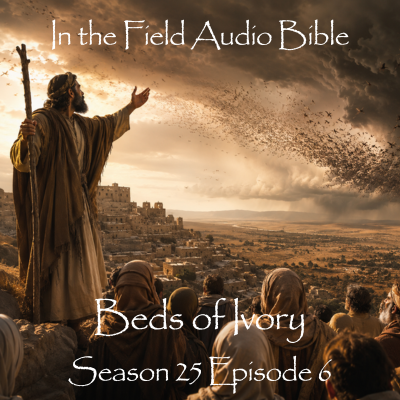
In a season of prosperity, a sharp voice names what many have learned to excuse. Beds of ivory become more than furniture, revealing a heart lulled to sleep while the vulnerable are crushed. Luxury continues without grief, worship language floats without repentance, and justice bends until it turns bitter. Strongholds cannot stop what God has decreed, and exile follows prideful security. Yet the invitation remains clear: turn, seek righteousness, and wake up.
The prophet’s voice cuts through the comfort of a thriving nation and asks what we do with blessings when they become a shield against compassion. This episode invites you into the public square—into the heat, the hush, and the holy confrontation—where beds of ivory become a symbol of ease that forgets the suffering of others. Come listen slowly, with an open heart, and let the Lord’s words search what we’ve learned to call normal.
What You’ll Experience in This Episode
- A narrative, storytelling journey into Amos’ public proclamation
- A clear warning spoken to Zion and Samaria—places of privilege and false security
- Vivid, lived-in imagery that helps you feel the weight of the message, not just hear it
- Space to pause, reflect, and respond with honesty before God
Key Themes (for Reflection)
- Comfort without compassion
- False security and spiritual numbness
- Justice turned bitter; righteousness distorted
- Worship language used as noise instead of surrender
- The Lord’s boundaries, the Lord’s oath, and the certainty of accountability
- The invitation to turn—before ease becomes captivity
Scripture Reading
- Amos 6 (with emphasis on Amos 6:1–7)
Memorable Images from the Story
- Beds of ivory and long couches—rest that has forgotten the poor
- Wine in bowls and costly oils—luxury that dulls grief
- Songs that imitate David—music without repentance
- Houses shattered—great house and little house alike
- A whispered command: “Silence”—fear replacing reverence
- A map traced from Lebo-hamath to the Brook of the Arabah—oppression drawn across the land
Gentle Reflection Questions
- Where has comfort made me less attentive to the needs of others?
- What do I call “peace” that might actually be avoidance, numbness, or denial?
- Is there any place I’ve turned worship into background noise instead of surrender?
- What grief have I refused to feel—because feeling it would require change?
- What would repentance look like for me this week in one concrete, humble step?
Prayer (Closing)
Lord God, You see what we hide beneath ease and routine. Wake what has grown sleepy in us. Soften what has grown hard. Where we have called comfort “peace” while ignoring the cries around us, forgive us and teach us to love what You love. Give us courage to turn—quickly, honestly, and completely. Make our worship true, our hands clean, our hearts tender, and our lives aligned with Your justice and mercy. In Jesus’ name, amen.
About This Podcast
In the Field Audio Bible is a quiet space to find rest, renewal, and steady joy in God’s living Word. Hosted by Christie, each episode is more than a reading—it’s a journey through Scripture with immersive storytelling, gentle reflection, and prayerful presence, created for weary hearts who want to draw near to Christ.
Subscribe + Share
If this episode met you in a needed place, subscribe so you don’t miss what’s next.
- Share this episode with a friend who needs a gentle wake-up call wrapped in grace
- Leave a review to help others find this quiet space in God’s Word
- Join the conversation in the comments: What line from Amos 6 stayed with you?
00:00 - Welcome And Settle Your Heart
03:17 - Walking North With Amos
06:35 - When Order Masks Exploitation
13:56 - The City That Forgot To Tremble
21:58 - Woe Spoken In Public
25:25 - Quiet Hearts Before The Reading
26:26 - Amos Chapter Six Read Aloud
29:25 - Exile And Justice Turned Bitter
40:40 - Turn From False Security
43:21 - Blessing, Farewell, And Share
In the Field Audio Bible:
The sun is already high enough to bleach the stones pale and make the air shimmer over the hills. The land around you is the kind of land that looks honest—hard soil, stubborn shrubs, a few olive trees gripping the slopes like hands that refuse to let go. The wind tastes of dry grass and distant smoke, and somewhere far off a shepherd calls to his flock, the sound thin and clear as it rides the heat. Amos walks beside you with the steady pace of someone who has spent his life outdoors. His mantle is plain. His hands are not the hands of a court prophet. They are the hands of a man who knows what it is to work, to wait, to watch the sky for rain and read the ground for signs of life. You glance at him and cannot help thinking how out of place he would look in a palace corridor—how quickly a guard would lift a spear, how quickly a servant would lower their eyes. And yet he is the one the Lord has chosen to send.
In the Field Audio Bible:
“Are we still going north?” you ask, because the road has begun to bend that way again—toward the places where stone walls rise higher, where gates are thicker, where the air smells less like sheep and more like oil and wine. Amos keeps his eyes on the path, as if the dust itself is giving testimony. “Yes,” he says. Just one word. But it lands like a weight. You walk a few steps in silence, letting the heat press against your shoulders. The road is familiar in the way all roads are familiar—dust, stones, thornbush, the occasional shade of a tree—but the purpose of this road is not ordinary. You are not traveling for trade. You are not traveling for family. You are traveling because the Holy One has a word that will not stay quiet.
In the Field Audio Bible:
You clear your throat. “Amos . . . do they know you’re coming?” A dry sound leaves his chest—almost a laugh, but not quite. “They know prophets,” he says. “They know how to nod at a warning and keep walking.” You step around a loose stone and keep your voice low. “And you? Do you ever wish the word was softer?” Amos’ jaw tightens, then loosens, like a man choosing truth over comfort. “I wish they were awake,” he answers. “Softness is not the problem. Sleep is.” The hills begin to open, and you can see farther. Terraces cut into the slopes like careful lines. Vineyards stretch in ordered rows. Fig trees stand with their broad leaves catching the light. The land looks prosperous. It looks secure. And that is what makes your stomach tighten. Because you know something Amos knows. Beauty can be real. And still be used to hide rot. A caravan passes you—donkeys with woven packs, men with sun-darkened faces, a boy walking barefoot with a stick in his hand. One of the men glances at Amos and then at you, measuring you the way people measure risk. Amos meets his eyes without flinching. The man looks away. You keep walking.
In the Field Audio Bible:
“Look at it,” you say, gesturing toward the terraces and the neat rows of vines. “It looks like blessing.” “It looks like order,” Amos replies. “Isn’t that the same thing?” you wonder. Amos’ voice stays calm, but there is iron under it. “Blessing makes room for the weak,” he says. “Order can be built on backs.” You want to ask him which backs. You want names. You want stories. But the land begins to answer for him. You pass a field where workers bend low, cutting stalks, gathering bundles. Their backs are curved. Their movements are quick, practiced, tired. A man on a rise watches them with a staff in his hand, not working—only counting. Your throat tightens. Amos’ voice comes quietly, as if he is speaking to you and to God at the same time. “Do you see?” You nod. “They’re fast,” you say. “Like they’re afraid to be slow.” “They are,” Amos answers. “Slow costs them. Slow invites the lash. Slow makes the overseer impatient.” You look again at the man counting, and you notice what you did not notice at first: the ease in his posture. The shade he stands in. The way he can watch suffering without feeling heat rise in his own skin. “Comfort,” Amos says, “can make a person forget what it cost.”
In the Field Audio Bible:
The road narrows near the gate. The stonework is impressive—large blocks fitted tight, the kind of construction that says, We are not going anywhere. Guards stand with spears. Merchants linger with baskets and jars. A woman adjusts her veil and steps aside to let a wealthy man pass. The wealthy man’s robe is clean. His sandals are new. He does not look at the woman. You feel heat rise in your chest. Amos notices. He tilts his head toward you, and his voice is low. “Do not let anger make you careless.” “Then what should I let it do?” you whisper. “Let it make you awake,” Amos says. “Let it make you honest.” You step into the shadow of the gate, and the world inside feels cooler—stone walls holding back the sun, courtyards opening like hidden rooms. The sound of water trickling somewhere. The smell of incense. The murmur of conversation. A man brushes past you, carrying a tray. Another laughs too loudly. Somewhere, someone reclines. And you realize something that makes your skin prickle. No one here is expecting God to interrupt. You look at Amos. “Why would they?” “Because they have learned to believe that being blessed means being safe,” he says.
In the Field Audio Bible:
You walk deeper into the city, and the streets widen. Houses rise with carved beams, with shaded porches, with doors that close out the world. You catch glimpses through open courtyards—cushions, low tables, bowls of fruit, cups that gleam. Your steps slow. You can almost hear the thought behind the walls. We have enough. We have more than enough. We have built a life that cannot be shaken. You pass an open doorway and see a room arranged for leisure: a couch set low, pillows stacked, a table laid out as if the day exists only for eating and music. A servant moves quietly, eyes lowered, careful not to disturb the ease of the one who reclines. You turn back to Amos. “Is this what you mean?” you ask. “The beds?” Amos’ gaze does not soften. “Yes,” he says. “They stretch out as if the world will always hold them.” You hesitate. “But feasting isn’t always evil.” “No,” Amos says, and his voice is steady enough to be kind. “But listen to me. When a people can sing while their brothers are sold, when they can tune instruments while justice is traded away, when they can anoint themselves with oils and never feel the wound of the nation—then their songs become a cover. Their perfume becomes a fog.”You swallow. “You said . . . they forget Joseph.” Amos nods once. “They forget the brokenness,” he says. “They forget what it means to be a family. They forget what it means to tremble.”
In the Field Audio Bible:
A breeze moves through the street, carrying laughter from an inner courtyard. It is bright laughter—untroubled, unhurried. You feel the contrast like a bruise. Amos stops. He turns to you, and for a moment, the noise of the city fades, as if the air itself is holding its breath. “This word,” he says, “is for those who are at ease.” You swallow. “Only for them?” “And for those who want to be them,” Amos adds. You blink. “That’s . . . most of us.” Amos’ eyes do not flinch. “Yes.” He continues, and his voice is not loud, but it is unmistakably firm. “For those who sit on high places and call themselves secure. For those who think the day of the Lord is far away—far enough to ignore, far enough to postpone, far enough to laugh at.” You glance around, suddenly aware of how exposed you are. A passerby looks at Amos with mild annoyance, as if prophets are inconvenient. A child stares at you, curious. You lean closer to Amos. “Are you going to speak here?” His answer is not a comfort. “I have been sent.” The sun shifts, and a blade of light falls across the stones at your feet. Dust swirls in it like tiny sparks. You think of how small you are. How small any one person is. And yet, you are here. Walking with a prophet. At the edge of a message that will not flatter anyone. Amos begins to move again, and you follow. “Stay close,” he says. “Why?” you ask. “Because ease is a fog,” Amos replies. “And fog makes people think they can’t fall.” You draw in a slow breath.
In the Field Audio Bible:
The city’s comfort presses in around you—soft voices, rich smells, the easy rhythm of people who have forgotten how to tremble. And then Amos speaks again, not to the crowd yet, but to you. “They think judgment is far away,” he says. You feel the words settle in your bones. “And is it?” Amos looks toward the inner courts, toward the houses that gleam, toward the places where leaders sit and decide what is fair. Then he says, “No.” You and Amos move deeper, and the city seems to open its arms the way a wealthy house opens its doors—wide enough to impress, narrow enough to control. The stones under your feet are smoother here. The dust is tamped down by constant traffic. The air carries the sweetness of pressed grapes and the sharpness of smoke from cooking fires. You pass a stall where a man is selling oil in small clay jars, his hands shining as if prosperity itself has left a residue on his skin. Amos watches him. You follow Amos’ gaze. “He’s just selling oil,” you say. Amos’ voice is quiet. “And someone else is paying for it.” You frown. “With money.” “With labor,” Amos replies. “With land. With debt that never seems to end.”
In the Field Audio Bible:
A woman steps out of a doorway with a basket of bread on her hip. She pauses when she sees Amos—just long enough for you to notice the caution in her eyes—then she turns away and disappears back into the shadow. You lean closer to Amos. “Do they recognize you?” “They recognize what I am,” he says. “A voice that won’t flatter them.” You pass another courtyard, and the sound of music spills out—strings, a drum tapped with lazy confidence, a laugh that rises and falls like it has never been interrupted by grief. You slow. “It’s beautiful,” you admit. “It is,” Amos says, and the honesty of his answer surprises you. He does not deny beauty. He does not pretend the fruit is bitter when it is sweet. But then he adds, “Beauty can be used like a curtain.” You swallow. “To hide what?” Amos does not answer right away. He leads you forward until the street bends, and suddenly the city’s height makes sense. You can see beyond the rooftops. You can see the way the hills cradle the strongholds. To the south, Zion—Jerusalem—rises with its ancient weight, its name spoken with reverence, its stones carrying the memory of kings and songs and sacrifices. To the north, Samaria sits like a crown on a hill—Israel’s proud seat—its walls thick, its houses bright, its leaders confident. Two names. Two centers. Two places that have learned to breathe in security like air.
In the Field Audio Bible:
You feel the words form in your mouth before you can stop them. “Zion,” you whisper. Amos nods. “And Samaria,” you add, and your voice tightens, because saying it out loud makes it real. Amos’ eyes are steady. “Yes.” You look from one direction to the other, as if your gaze could bridge the distance between them. “But Zion is . . . the holy city,” you say carefully. “And Samaria—this is where the leaders sit. These are the places people point to when they say, ‘We are safe.’” Amos’ expression does not harden. It clarifies. “Woe,” he says, and the word is not shouted. It is spoken like a verdict that has been waiting. You inhale. “You’re going to say that?” “I will,” Amos answers. “Because the Lord has said it.” You glance around, suddenly aware of how many ears might be listening. “Here? In the street?” Amos’ voice lowers. “In Zion. In Samaria. In every place where people have learned to call ease ‘peace.’” A shout of laughter rises from behind a wall. The scent of roasted meat drifts out from an inner courtyard. A servant slips past with a tray, eyes down, moving like a shadow. You feel the city’s comfort like a hand trying to cover your mouth.
In the Field Audio Bible:
Amos steps forward anyway. Not into a pulpit. Into the open. He draws a breath, and you feel it like a change in weather. Heads turn. A jar of oil pauses mid-pour. A man with a ringed hand stops talking. A woman with bread slows, listening without looking like she is listening. Amos lifts his voice, and it carries with the weight of the Lord behind it. “Woe to those who are at ease in Zion,” he declares. Zion is named plainly, not sung. “And to those who feel secure on the mountain of Samaria.” Samaria is named plainly, not excused. The names hang in the air like a verdict. You stand beside him, hands cold, heart loud, as the opening of Amos’ proclamation lands in the street—an arrow aimed not at their wealth, but at their false peace. Amos’ gaze sweeps the notable men, the leaders who have learned to recline while others bend. “Those who are the notable men of the first of the nations,” he says, “to whom the house of Israel comes.” Then his voice tightens, and the next words come like a door being opened onto a wider world. “Pass over to Calneh, and see,” Amos says. “And from there go to Hamath the great; then go down to Gath of the Philistines.” You feel the crowd shift. Because he is not only calling out Zion and Samaria. He is calling out the lie that says, We are different. We are safe. We are untouchable. “Are you better than these kingdoms?” Amos asks. The question hangs. And you feel the city’s ease tremble—just slightly—as if comfort itself has realized it has been named.
In the Field Audio Bible:
“You who put far away the day of disaster,” Amos says, and the street seems to lean in despite itself, “and bring near the seat of violence . . .” You swallow. Seat of violence. Not only swords. But the quiet violence of injustice that has learned to wear perfume. Amos’ voice does not soften. It steadies. And you realize the Lord has brought you here not to admire a city, not to envy its ease, not to hate its people. But to stand close enough to hear the first words of truth as they are spoken in public—spoken where they can be rejected, mocked, or believed. You stay beside Amos. Because the proclamation has begun. And there is no going back to sleep.
In the Field Audio Bible:
Now, let’s take a moment to quiet our hearts and listen to the Word itself. As you hear these verses, let them settle deep within you—bringing comfort when you’re weary, conviction when you need direction, and encouragement for whatever lies ahead. Whether you are nestled in a quiet corner or moving through the busyness of your day, allow God’s Word to meet you right where you are and speak to your soul in this very moment. I hope you have your favorite cup of tea or coffee. Sit back, relax, and let’s step into the sacred text of The Book of Amos Chapter 6.
In the Field Audio Bible:
The Book of Amos 6 (NRSV):
1 Woe to those who are at ease in Zion
and for those who feel secure on Mount Samaria,
the notables of the first of the nations,
to whom the house of Israel resorts!
2 Cross over to Calneh and see;
from there go to Hamath the great;
then go down to Gath of the Philistines.
Are you better than these kingdoms?
Or is your territory greater than their territory,
3 you who put far away the evil day
and bring near a reign of violence?
4 Woe to those who lie on beds of ivory
and lounge on their couches
and eat lambs from the flock
and calves from the stall,
5 who sing idle songs to the sound of the harp
and like David improvise on instruments of music,
6 who drink wine from bowls
and anoint themselves with the finest oils
but are not grieved over the ruin of Joseph!
7 Therefore they shall now be the first to go into exile,
and the revelry of the loungers shall pass away.
8 The Lord GOD has sworn by himself
(says the LORD, the God of hosts):
I abhor the pride of Jacob
and hate his strongholds,
and I will deliver up the city and all that is in it.
9 If ten people remain in one house, they shall die.
10 And if a relative, one who burns it, takes up the body to bring it out of the house and
says to someone in the innermost parts of the house, “Is anyone else with you?” the
answer will come, “No.” Then the relative shall say, “Hush! We must not mention
the name of the LORD.”
11 For the LORD commands,
and he will shatter the great house to bits
and the little house to pieces.
12 Do horses run on rocky crags?
Does one plow the sea with oxen?
But you have turned justice into poison
and the fruit of righteousness into wormwood,
13 you who rejoice in Lo-debar,
who say, “Have we not by our own strength
taken Karnaim for ourselves?”
14 Indeed, I am raising up against you a nation,
O house of Israel, says the LORD, the God of hosts,
and they shall oppress you from Lebo-hamath
to the Wadi Arabah.
In the Field Audio Bible:
The crowd thins the way heat thins the air—slowly, reluctantly—until the open place feels too wide for the number of bodies still standing in it. Dust hangs in the light like a veil. Somewhere behind you, a donkey brays, sharp and impatient, and a child answers with a laugh that is quickly hushed. The sun presses down on every head uncovered—linen headcloths pushed back, hair damp at the temples, faces shining with sweat and stubbornness. Amos does not step down. He stands where he has been standing, shoulders squared beneath a rough outer cloak that looks like it has known long roads and cold nights. The cloth is sun-faded, the seams repaired more than once. He is not dressed like the men who drift in and out of shaded colonnades with perfumed beards and rings on their fingers. He is dressed like a man who has slept under the open sky and woken with grit in his teeth—like a man who has carried water in cracked-skin bags and watched them leak until thirst becomes a teacher.
In the Field Audio Bible:
You feel the weight of his silence before he speaks again—like the pause between thunder and the strike. He looks out over the last clusters of listeners: merchants with their scales and ledgers tucked under their arms, women with jars balanced on hips, older men leaning on staffs polished by years, younger men with arms crossed as if to hold themselves together. Some have stayed because they are angry. Some because they are curious. Some because they cannot quite leave, not with his words still moving through them like a stone dropped into a well. And you are still here. Amos lifts his chin, and his voice carries again, not because he shouts, but because it is sharpened by conviction. “Woe to those who are at ease,” Amos exclaims. The word woe lands heavy, ancient, familiar—the kind of word the prophets have always used when heaven leans close to earth and speaks judgment. It is not a curse thrown in temper. It is a pronouncement, a verdict, a warning wrapped in grief. A man near the edge scoffs that they have peace, as if peace is proof.
In the Field Audio Bible:
“Peace,” Amos repeats, and there is no softness in it. “You call it peace because your walls are thick and your storehouses are full. You call it peace because your children eat and your wives wear bracelets of bronze and silver. You call it peace because the king’s men ride past and do not stop at your door,” Amos says. “But what do you call it when the poor man sells his cloak to buy bread? What do you call it when the judge takes a bribe and the innocent is turned away? What do you call it when you lie down at night and do not hear the crying because you have trained your ears not to?” Amos demands.
In the Field Audio Bible:
Amos’ gaze sweeps again, and his words begin to paint, not merely accuse. He names what they love. He names what they have built. He names the texture of their comfort. “You lie on beds of ivory,” Amos says, and you can almost see them—carved panels, polished smooth, inlaid with pale bone and gleaming wood. Beds are not made for necessity, but for display. “You stretch yourselves out on your couches, long and unhurried, while the day passes and the laborer’s back bends under the sun,” Amos adds. “You eat lambs from the flock and calves from the midst of the stall—meat chosen, fattened, tender. You sing idle songs to the sound of the harp, and you invent for yourselves instruments of music like David,” Amos declares.
In the Field Audio Bible:
At the name of David, pride ripples through the listeners—nostalgia, the warmth of a national story. David the shepherd-king. David the psalmist. Songs that were once prayer. But Amos does not let them keep David as decoration. “You borrow the language of worship,” Amos says, “and you use it to bless your ease. You take what was meant to lift the heart toward God and you turn it into background noise for feasting,” Amos warns. “You drink wine in bowls, not cups, as if moderation is for the weak. You anoint yourselves with the finest oils—oil that smells like gardens you did not plant, like spices you did not grind, like wealth that came through hands you do not see; But you are not grieved over the ruin of Joseph,” Amos says. Joseph is not only a man. Joseph is a history—the memory of betrayal and redemption, famine and provision, exile and return. Joseph is the northern house—Samaria’s pride—Israel calling itself secure because it still wears the name. Not grieved. Not moved. Not awake.
In the Field Audio Bible:
“Therefore you shall now be the first of those who go into exile,” Amos proclaims. A laugh breaks out—too loud, too quick. Exile, someone says. From where? We are in our land. “You think land is yours because your feet stand on it,” Amos answers. “But land is the Lord’s. He gives and He takes. He plants and He uproots,” Amos says. “You will be carried, and the revelry of those who stretch themselves out shall pass away,” Amos says. Amos does not leave them with a vague threat. He speaks as if he has already seen the thing happen, as if the Lord has pulled back the curtain and shown him the end. “The Lord God has sworn by Himself,” Amos says. “The Lord, the God of hosts, declares: ‘I abhor the pride of Jacob, and I hate his strongholds,’” Amos recites. Strongholds—walls and gates, towers and storehouses, the places people run when they are afraid. The places they trust more than the God who brought them out of Egypt.
In the Field Audio Bible:
“‘I will deliver up the city and all that is in it,’” Amos continues. Fear moves through the square now, not anger. The kind of fear that makes people look at their own hands, as if to check whether they are still real. “‘If ten men remain in one house, they shall die,’” Amos says. Death is no longer a distant rumor. It enters the home. A relative comes to carry the body out and calls into the innermost part of the house: “Is anyone still with you?” The answer is no. And then the warning, sharp as a blade: “Silence. We must not mention the name of the Lord,” the relative says. “Listen,” Amos says. “Behold, the Lord commands, and the great house shall be struck down into fragments, and the little house into bits,” Amos declares. Great house, little house—the mansion and the hut. Judgment does not stop at the threshold of privilege. “Why would God do this?” someone whispers. “Because you have turned justice into poison. Because you have made righteousness bitter,” Amos replies.
In the Field Audio Bible:
“Do horses run on rocks? Does one plow there with oxen? And yet you have done what is madness. You have taken what was meant to be straight and you have bent it. You have taken what was meant to heal and you have made it harm,” Amos says. Someone shouts that they are strong, that they have victories, as if conquest is a certificate of holiness. “You rejoice in Lo-debar,” Amos says, “and you say, ‘Have we not by our own strength captured Karnaim?’” Amos quotes. “By your own strength—as if breath is yours, as if the next heartbeat is yours, as if the Lord does not raise up nations and bring them down like waves,” Amos says. “Therefore, behold, I will raise up against you a nation, O house of Israel,” Amos declares. “And they shall oppress you from Lebo-hamath to the Brook of the Arabah,” Amos says. He names the boundaries—north to south—like drawing a line across a map with a blade. The whole land. No corner untouched. The square is quiet now in a way it was not at the beginning. The scoffers have less to say. The curious have stopped smiling. Even the angry look uncertain, because anger is easy when you believe you are safe. Amos stands in the aftermath of his own words, breathing, steadying himself. His cloak stirs in a faint breeze that does not cool anything, only moves the dust.
In the Field Audio Bible:
Then, softer but not less firm, he speaks again, as if turning toward the ones who are still listening with their hearts, not just their ears. “You think ease is blessing. You think comfort is proof. You think abundance is God’s endorsement,” Amos says. “But the Lord is not impressed by your couches. He is not persuaded by your songs. He is not bought by your oil,” Amos says. “He wants your heart. He wants your hands clean of violence. He wants your mouth to speak truth. He wants your gates—your courts, your judgments, your daily dealings—to be places where the poor are not crushed and the righteous are not mocked,” Amos says. A long pause follows. The creak of leather. The rustle of linen. A bird calling high above the city. “What do we do?” someone finally asks, voice small. “Turn,” Amos says. “Turn from your ease if your ease is built on another man’s hunger. Turn from your pride if your pride has made you deaf. Turn from your false security if your security has made you cruel,” Amos says. “The Lord has spoken,” Amos says. And Amos lets his arm fall. He does not wait for applause. He does not wait for agreement. He does not chase them down the street to make them understand. He has delivered what was given to him.
In the Field Audio Bible:
But the words remain—hanging in the heat, settling into the cracks of the city like dust, following people home on their sandals, slipping into their houses through open doors, lingering over their tables, waiting beside their beds of ivory. And you stand there with the sun still high, with the prophet still in front of you, with the land still under your feet, wondering whether you will walk away unchanged, or whether you will finally let the Lord’s voice reach the place in you that has been too comfortable to listen.
In the Field Audio Bible:
Thank you for sharing this sacred moment with me as we explored these words of hope together. May these words take root in your heart, guiding you through the days ahead and reminding you that God walks beside you—in every challenge, every decision, and every act of faith. If today’s reflection has brought you hope or comfort, I invite you to pass it along to someone who might need a gentle reminder of God’s presence. And don’t forget to come back next time as we continue this journey—growing together, deepening our faith, and remaining steadfast “in the field” of God’s promises. Until next time, may you discover peace in quiet moments, trust the gentle call of God, and rest securely in His unchanging love.
This is In the Field Audio Bible—where we Listen to the Bible One Chapter at a Time.