Apple Podcasts
 Spotify
 Youtube Music
 iHeartRadio
 Amazon Music
 Podchaser
 JioSaavn
  RSS Feed
 Walls Within Walls: When Brothers Devour Brothers
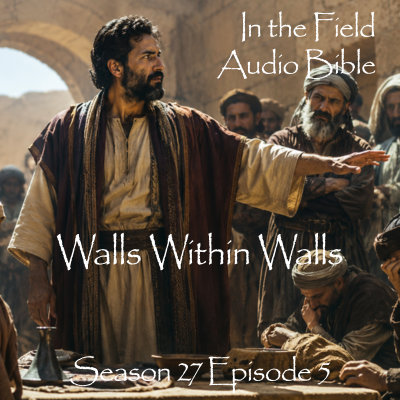
The wall is rising and the dust is thick, but Jerusalem is battling walls within walls as hunger and debt turn neighbor against neighbor. Families plead for grain, mortgage fields and homes, and face the unthinkable as children become payment. Nehemiah listens, restrains his anger, and brings the crisis into the open, confronting nobles who hide greed behind custom. He calls for specific repentance stop the usury, restore property, return what was taken, and swear an oath before God.
The danger isn’t only outside Jerusalem’s rising walls—it’s within the community itself: walls within walls. As the dust of rebuilding hangs in the air, a cry rises from hungry families whose land, labor, and even children have been leveraged for survival. This episode brings you shoulder-to-shoulder with Nehemiah as he confronts injustice with courage, calling God’s people away from comfort and beds of ivory and back to covenant faithfulness.
What You’ll Experience in This Episode
- Immersive, cinematic storytelling that places you in the streets of Jerusalem during the rebuilding
- The voices of ordinary families as they describe famine, debt, and the crushing weight of exploitation
- Nehemiah’s leadership in real time: listening, discerning, confronting, and restoring
- A public reckoning that turns private greed into a community-wide call to repentance
Key Themes (for Reflection)
- Internal battles: when the greatest threat is not an enemy at the gate, but sin within the people
- Economic justice: debt, interest, and the misuse of power against the vulnerable
- Covenant integrity: what it means to “walk in the fear of God” in everyday decisions
- Repentance with fruit: restoration that is immediate, measurable, and public
- Leadership under pressure: righteous anger disciplined into courageous action
Scripture Reading
- Nehemiah 5 (full chapter)
Memorable Images from the Story
- Dust and wet mortar clinging to clothing as the wall rises stone by stone
- A ring of families gathering—hollow-eyed children, tightened belts, empty hands lifted in appeal
- Silver pouches clinking at the belts of nobles while the poor speak of hunger
- Nehemiah calling the matter into the open air, where truth cannot hide
- A garment shaken out in warning—dust falling like a verdict before the people say, “Amen”
Gentle Reflection Questions
- Where do you see “walls rising” in your life—visible progress—while something unseen is breaking underneath?
- When you feel righteous anger, how do you usually respond: impulsively, silently, or with disciplined courage?
- Are there places where comfort has dulled compassion—where you’ve drifted toward “beds of ivory” while others carry heavy burdens?
- What would restoration look like in a real, practical way—today, not someday?
- How might God be inviting you to protect the vulnerable and confront injustice with humility and clarity?
Prayer (Closing)
Lord God, teach us to walk in the fear of You—more than the fear of loss, more than the fear of conflict, more than the fear of what others will think. Give us eyes to see the burdens around us, and courage to confront what is not good. Where we have benefited from systems that harm others, lead us into repentance with real fruit. Make us people who rebuild with clean hands and steady hearts—restoring what was taken, lifting what has been crushed, and honoring Your covenant in the ordinary choices of our days. In Jesus’ name, amen.
About This Podcast
In the Field Audio Bible Podcast is an immersive, narrative journey through Scripture—bringing you into the world of the Bible with historical context, cultural detail, and reflective discipleship. Each episode is designed to help you not only understand God’s Word, but to live it—and to disciple others with gentleness, courage, and truth.
Subscribe + Share
If this episode strengthened you, consider subscribing so you don’t miss what comes next in Nehemiah’s story. Share this episode with a friend, a small group, or someone rebuilding under pressure—because God’s Word is meant to be carried together.


00:00 - Sponsor Message And Opening
01:08 - Welcome To A Quiet Scripture Space
03:12 - Walking The Wall With Nehemiah
07:06 - The Famine, Debt, And Desperation
16:49 - Children Taken As Payment
31:47 - Preparing To Hear Nehemiah 5
32:47 - Scripture Reading Nehemiah Chapter 5
37:34 - Fear Of God Over Profit
50:08 - Restore What Was Taken Today
01:00:24 - Closing Blessing And Share Prompt
In the Field Audio Bible:
You step out into Jerusalem as if the city has been breathing dust all night and never stopped. The air is sharp with lime and crushed stone, and it clings to your tongue. It settles into the folds of your clothing—into the seams where sweat has dried and dried again. Everywhere you look, men move with the stiff rhythm of labor: shoulders braced, hands raw, eyes scanning the ridgeline beyond the wall as though danger might rise out of the hills like a second sunrise. The wall is higher than it was. Not finished—never finished, not yet—but higher. The gaps are narrower. The gates, still skeletal, stand like ribs waiting for breath. Nehemiah walks beside you, his cloak drawn close against the morning chill. It’s a governor’s cloak, but it has the dust of a builder on it. His sandals are scuffed. His hands, when he lifts them to gesture toward the work, are not the hands of a man who only signs decrees. He has been among the stones. He has been among the people. He slows as you pass a stretch where the mortar is still fresh, pale against darker rock. The scent of wet lime rises when the breeze turns. Nehemiah glances at you as though he expects you to notice what he notices.
In the Field Audio Bible:
“Do you hear it?” he asks quietly—not the shout of a commander, but the careful question of a man who has learned that danger often arrives as a whisper before it becomes a roar. You stop with him. You listen again, letting the city’s sounds separate like threads in your hands. There’s the scrape of rock, the thud of timber, the clink of tools—yes. But beneath it, something else. A rough, uneven sound, like wind catching in a torn cloth. “Not the tools,” you say, uncertain at first, then more sure as the sound sharpens. “It’s . . . voices. People crying out.” Nehemiah nods once, and his eyes tighten. “Yes,” he says. “And it is not coming from the wall.” He turns his body slightly, and without grabbing your arm or rushing you, he guides you away from the clean line of stone toward the edge of the worksite, where the ground dips and the footpaths braid together. As you walk, the sun climbs higher, warming the stone underfoot. The smell of sweat and dust thickens. A breeze slides through a gap in the wall and carries the faint tang of wet mortar and old smoke from cooking fires that have burned too low. With every step, the sound grows clearer—less like murmuring, more like a cry that has been held back too long.
In the Field Audio Bible:
You see them before you reach them: a cluster of women standing near the outskirts of the labor, close enough to be seen but far enough to be ignored by those who want to keep their minds on stones and blades. Their head coverings are pulled tight, their faces drawn. Some hold children on their hips—little ones with dusty cheeks and hollow eyes. A few older boys stand near them, trying to look like men, but their shoulders sag with the weight of hunger. Men gather too—farmers, laborers, fathers—some in the rough tunics of fieldwork, others in patched garments that tell you exactly how long a household has been stretching what it has. Their belts are tied tighter than usual, as if cloth could make up for the lack of bread. Their hands are not lifted to build. They are lifted in appeal. The outcry swells as Nehemiah approaches, and the people nearest begin to turn, recognizing him the way parched ground recognizes rain. “There is a great outcry,” Nehemiah murmurs, almost to himself, and you realize he is naming what he hears the way a physician names a fever. Then he says it aloud, so you—and the people nearest—cannot miss the weight of it. “Against their Jewish brothers.” You swallow. “Against . . . their own?” you whisper, as if saying it softly might make it less true. Nehemiah’s gaze stays on the crowd as he keeps walking, slow enough that no one feels pushed aside, steady enough that no one doubts he will stop. “That is what we must face,” he answers. “A people can survive enemies at the gates. But if brothers devour brothers, the city collapses from the inside.”
In the Field Audio Bible:
He comes to a stop where the footpaths widen into a dusty open space—an in-between place where workers pass through, and families wait. The crowd gathers in a loose ring, drawn by the gravity of being finally heard. Nehemiah doesn’t raise his voice yet. He lets the cries speak themselves into the open air, letting the truth come out in the language of the people. A woman near the front steps forward, shifting her child higher on her hip. Her voice shakes, but it does not break. It is the voice of someone who has been counting grain kernels like coins. “We, our sons, and our daughters are many,” she says, eyes flashing with both shame and courage. “Therefore, we must get grain, that we may eat and live.” Nehemiah’s face softens, just slightly—enough for her to know she is not invisible. “How long has there been no grain in your house?” he asks. “Long enough that my little one cries at night and my breasts are dry,” she answers, and the words land like a stone dropped into still water. “Long enough that we boil what should be seed.”
In the Field Audio Bible:
Nehemiah nods slowly, absorbing it. He shifts his stance, turning so the ring of people can see his face, can see he is listening—not scanning for threats, not calculating politics, but listening like a shepherd counts sheep. “And when the jar was empty,” he asks, “what did you do?” A man beside the woman steps forward, his tunic dusty at the knees as if he has been kneeling in more than prayer. He lifts his hands, palms outward, as if showing they are empty. “We mortgaged our fields and our vineyards and our houses,” he says, the words coming out like stones from a sling, “that we might buy grain because of the famine.” Nehemiah turns toward him, and as he does, you notice how the crowd shifts too—bodies leaning, faces turning, the story moving through them like a current. “Whose hand holds your field now?” Nehemiah asks. The man hesitates, glancing over his shoulder as if the name itself might cost him. “A noble,” he admits. “A brother with silver.” Heat rises in your chest. The wall behind you is still being built—men still hauling stone, still setting beams—yet here, in the shadow of that labor, people are losing the very land they hoped to return to. “So the poor build the wall,” you say, voice tight, “and the rich take their land while they build it?” Nehemiah looks at you—not to silence you, but to steady you. “Speak truth,” he says quietly, “but do not let anger make you careless.”
In the Field Audio Bible:
Before you can answer, the ring opens again as another man pushes forward—older, beard streaked with gray dust, tunic hanging looser than it should. He moves like someone who has walked a long distance on little food. “We borrowed money for the king’s tax,” he says, and you hear the bitterness under the restraint, “on our fields and our vineyards.” Nehemiah’s eyes narrow. He steps closer—not looming, but closing the distance so the man doesn’t have to shout his shame. “And when you could not pay?” he asks. The older man’s throat works. “Interest,” he says. “A bite taken every month.” He gestures toward the women, toward the children. “And when we could not keep up . . . they took our children.” The words ripple outward. A murmur rises, then breaks, as if the crowd cannot hold it any longer. A woman’s voice cuts through—thin with desperation and fury. She steps into the open, and you see the way her hands tremble, not from weakness, but from restraint. “Now our flesh is as the flesh of our brothers,” she says, and her words are a knife because they should not need to be spoken. “Our children as their children. Yet behold—we are forcing our sons and our daughters to be slaves.”
In the Field Audio Bible:
A hush follows, the way a courtyard goes quiet when someone speaks a truth everyone has been circling but refusing to name. You whisper, shaken, “Slaves . . . here?” Nehemiah answers without looking away from the faces in front of him. “In the city of God,” he says, quiet only because his anger is disciplined. “Under the shadow of this wall.” The woman’s eyes shine with tears that do not fall. She swallows hard, as if she has swallowed grief for weeks, and it has finally become too heavy. “Some of our daughters are forced into bondage already,” she says, voice dropping as if the shame itself is heavy. “And we are helpless, because our fields and our vineyards belong to others.” Nehemiah closes his eyes for a brief moment, as if he is holding his anger in his hands so it will not spill and burn the wrong people. When he opens them, he turns slightly toward you, and his voice drops—private, but not secret. “This,” he says under his breath, “is what the enemy loves most.” You frown, trying to follow. “But these are our own people,” you whisper. “How can this be the enemy’s work?” Nehemiah’s gaze stays steady. “Because the enemy does not always need a sword,” he says. “Sometimes he only needs hunger. Sometimes he only needs fear.” His eyes lift, scanning the ring of faces. “When they cannot break the wall with threats, they try to break the people from within.”
In the Field Audio Bible:
As he speaks, his attention drifts past torn garments and hollow cheeks—toward the men standing farther back, half in sun and half in shade, watching with guarded faces. They are dressed differently. Their garments are cleaner. Their belts hold small pouches that clink softly when they shift. Some wear signet rings. Their sandals are newer. Nobles and officials—men with means, men who lend, men who take land as security. You lean toward Nehemiah. “They’re here,” you murmur. “They’ve been listening.” Nehemiah’s mouth tightens. “Yes,” he says. “And they will speak—because we will not keep this in the shadows.” He takes a few steps forward, and you move with him. The crowd parts instinctively, not because they are afraid of him, but because they are making room for justice to walk into the center. Nehemiah raises his hand, and the murmurs thin. He does not shout. He does not need to. The authority in him is not only Persian—it is covenantal. It is the weight of a man who knows God’s law and refuses to let it be trampled under a pile of contracts. “You are exacting usury,” Nehemiah says, voice ringing out so the whole assembly can hear. “Each from his brother.” A noble steps forward, chin lifted, as if the accusation itself is an insult. His robe is dyed deeper than most—expensive color, carefully kept. He spreads his hands in a gesture that looks reasonable, almost compassionate, if you don’t listen too closely.
In the Field Audio Bible:
“Governor,” the noble says, smooth and controlled, “we did not take anything. We lent.” An official beside him nods quickly, eager to add structure to the defense. “There are customs,” he says. “If a man borrows, he pledges security. Land is security. A vineyard is security. A house is security.” Nehemiah’s eyes stay on them. He doesn’t flinch. “And children?” he asks, voice even. “Are children security too?” The official’s jaw tightens. “If a household cannot repay,” he says, choosing his words like a man stepping around a pit, “service is a way to settle a debt.” The noble’s gaze sweeps the poor with a practiced look that pretends to be sorrow. “If there is famine,” he says, “grain must be purchased. Grain costs silver. If there is tax, silver must be found. Where will it come from, if not from those who have it?” A murmur rises—some agreement from those who fear losing their own standing, some anger from those who have nothing left to lose. The official lifts his chin. “And if we lend without protection,” he adds, “we endanger our own households. We have children, too. We have obligations.” He gestures toward the wall behind you, as if the stones themselves support his argument. “This work has halted the fields. Men are here instead of harvesting. Everyone is strained. Everyone is sacrificing.” The noble’s voice softens, becoming almost paternal. “We offered a way,” he says. “Work off the debt. Serve until it is paid. It is not cruelty—it is order.” You feel your hands curl into fists at your sides. The sun is bright now, and the dust in the air turns the light hazy, as if the city itself is squinting at what it has become.
In the Field Audio Bible:
“Order?” you say, and your voice comes out louder than you intended. Heads turn toward you. “Is it order to take a boy’s strength and call it mercy? Is it order to reach for a young girl because her parents are hungry?” The noble’s eyes flick to you, cool and assessing. “And will you pay their debt?” he asks, sharp now. “Will you feed them? Will you answer the king’s collector when he comes?” Before you can respond, movement stirs at the edge of the ring—like a wound that can’t stay covered. A family shifts forward, hesitant, pushed by the weight of the moment. A man stands there with shoulders that used to be broader. His tunic is sun-faded and mended at the elbows. His hands—hands that should be holding a tool—hang open at his sides like he has nothing left to offer. Beside him, a woman holds herself upright with sheer will, her scarf pulled forward to shade her face. Between them stands a boy on the edge of manhood—tall, thin, jaw clenched so hard you can see the muscle jump. Nehemiah’s gaze finds them immediately, and he steps toward them as if the crowd itself makes a path. “What is your name?” Nehemiah asks the man. “Hanan,” the man says, voice rough. “Son of Malchiah.” “And your household?” Nehemiah asks, eyes moving to the woman and the boy. “I am Tirzah,” the woman answers, steady in a way that tells you she has been steady for everyone else. “This is our son—Joel.” Nehemiah nods. “Tell me,” he says, “what has been taken from you?”
In the Field Audio Bible:
Hanan swallows. “Our field,” he says. “A strip of barley land outside the city. It was not much, but it was ours.” He lifts his hands again, palms outward. “We pledged it for grain.” “For grain,” Tirzah repeats, and the bitterness in her mouth makes the words taste like ash. “Because the men are here on the wall. Because the children cannot eat stones.” Joel’s voice breaks through, sharp and young. “Because the tax collector doesn’t care if we’re rebuilding,” he says. “He only cares if we pay.” Nehemiah’s eyes flick to the boy. “And what did they demand when you could not pay?” he asks. Joel’s throat works, and for a moment you think he won’t say it. Then he forces the words out like a confession he hates. “They said I could work it off,” he says. “They said it would be for a season. Just until the harvest.” Hanan’s face twists. “But the harvest belongs to them now,” he says quietly. “And the season keeps stretching.” Tirzah’s fingers tighten on her scarf. “They asked for our daughter too,” she says, and her voice drops. “Mara. She is twelve.” A sound moves through the crowd—half gasp, half groan. Tirzah’s eyes are bright, but she refuses to let tears fall in front of men who have already taken too much. “She is still with us,” Tirzah says quickly, as if she must defend herself from judgment. “For now. But they said . . . the debt is a mouth that must be fed.” The noble’s expression tightens—annoyance, not grief. “If you pledge,” he says, “you must honor the pledge.”
In the Field Audio Bible:
Joel steps forward suddenly, as if the air itself has pushed him. His voice shakes, but it holds. “We are not asking for luxury,” he says. “We are asking to live.” Hanan reaches for his son’s arm. “Joel—” Joel doesn’t move. “My father builds,” he says, pointing toward the wall. “My mother stretches flour until it is dust. And they say my sister is part of the payment.” His eyes flash. “Is that the law of our God?” The official’s face hardens. “Boy,” he snaps, “do not—” Nehemiah’s hand lifts, and the official’s voice dies in his throat. Nehemiah looks at Joel for a long moment—long enough that the boy’s breathing slows, long enough that courage settles into him like a cloak. “You have spoken,” Nehemiah says, “what many have been afraid to say.” Then Nehemiah turns to you, just for a heartbeat, and you see the weight in his eyes—the weight of leading people who are both wounded and wounding. “What do you see?” he asks you softly, as if discipling you in real time. You swallow, tasting dust. “I see hunger,” you say. “I see fear. And I see fear being used like a knife—so the strong can cut the weak and call it necessity.” Nehemiah nods once. “Yes,” he says. “And now we will bring it into the light.” The sun is higher now, bright on the stone, bright on the sweat at men’s temples. Somewhere nearby, a hammer strikes a nail—steady, rhythmic like a heartbeat. The wall continues to rise. But the city is holding its breath. Nehemiah turns back to the nobles and officials. His posture shifts—still among the dust, still close enough to smell the mortar—but standing now like a man who will not bargain with injustice. He draws in a breath, and when he speaks, his words begin to gather like thunder at the edge of the sky. “The thing which you are doing is not good,” he says, and the air itself seems to still around the sentence. You feel it—this is where his wisdom will cut through every defense that has dressed itself up as survival.
In the Field Audio Bible:
Now, let’s take a moment to quiet our hearts and listen to the Word itself. As you hear these verses, let them settle deep within you—bringing comfort when you’re weary, conviction when you need direction, and encouragement for whatever lies ahead. Whether you are nestled in a quiet corner or moving through the busyness of your day, allow God’s Word to meet you right where you are and speak to your soul in this very moment. I hope you have your favorite cup of tea or coffee. Sit back, relax, and let’s step into the sacred text of The Book of Nehemiah Chapter 5.
In the Field Audio Bible:
The Book of Nehemiah 5 (NRSV):
1 Now there was a great outcry of the people and of their wives against their Jewish kin.
2 For there were those who said, “With our sons and our daughters, we are many; we must get grain, so that we may eat and stay alive.”
3 There were also those who said, “We are having to pledge our fields, our vineyards, and our houses in order to get grain during the famine.”
4 And there were those who said, “We are having to borrow money on our fields and vineyards to pay the king’s tax.
5 Now our flesh is the same as that of our kindred; our children are the same as their children; and yet we are forcing our sons and daughters to be slaves, and some of our daughters have been ravished; we are powerless, and our fields and vineyards now belong to others.”
6 I was very angry when I heard their outcry and these complaints.
7 After thinking it over, I contended with the nobles and the officials; I said to them, “You are all taking interest from your own people.” And I called a great assembly to deal with them
8 and said to them, “As far as we were able, we have bought back our Jewish kindred who had been sold to other nations, but now you are selling your own kin, who must then be bought back by us!” They were silent and could not find a word to say.
9 So I said, “The thing that you are doing is not good. Should you not walk in the fear of our God, to prevent the taunts of the nations our enemies?
10 Moreover I and my brothers and my servants are lending them money and grain. Let us stop this taking of interest.
11 Restore to them, this very day, their fields, their vineyards, their olive orchards, and their houses, and the interest on money, grain, wine, and oil that you have been exacting from them.”
12 Then they said, “We will restore everything and demand nothing more from them. We will do as you say.” And I called the priests and made them take an oath to do as they had promised.
13 I also shook out the fold of my garment and said, “So may God shake out everyone from house and from property who does not perform this promise. Thus may they be shaken out and emptied.” And all the assembly said, “Amen,” and praised the LORD. And the people did as they had promised.
14 Moreover, from the time that I was appointed to be their governor in the land of Judah, from the twentieth year to the thirty-second year of King Artaxerxes, twelve years, neither I nor my brothers ate the food allowance of the governor.
15 The former governors who were before me laid heavy burdens on the people and took food and wine from them, besides forty shekels of silver. Even their servants lorded it over the people. But I did not do so because of the fear of God.
16 Indeed, I devoted myself to the work on this wall and acquired no land, and all my servants were gathered there for the work.
17 Moreover, there were at my table one hundred fifty people, Jews and officials, besides those who came to us from the nations around us.
18 Now that which was prepared for one day was one ox and six choice sheep; also fowls were prepared for me, and every ten days skins of wine in abundance, yet with all this I did not demand the food allowance of the governor, because of the heavy burden of labor on the people.
19 Remember for my good, O my God, all that I have done for this people.
In the Field Audio Bible:
Nehemiah turns back to the nobles and officials. His posture shifts—still among the dust, still close enough to smell the mortar—but standing now like a man who will not bargain with injustice. He draws in a breath, and when he speaks, his words gather like thunder at the edge of the sky. “The thing which you are doing is not good,” he says, and the air itself seems to still around the sentence. For a heartbeat, no one moves. Even the work on the wall feels distant, as if the city itself is listening. Then, somewhere behind you, a hammer strikes again—steady and patient—reminding everyone that the stones will not stop rising just because hearts are being exposed. Nehemiah takes a few slow steps into the center of the ring, and you move with him. The crowd tightens without anyone commanding it—men and women edging closer, children peering between elbows, the poor holding their breath as though they’ve been underwater for weeks. The nobles remain farther back at first, half in sun and half in shade, as if distance could protect them. Nehemiah’s eyes sweep across the circle—across signet rings and clean hems, across hollow cheeks and cracked hands—and then he speaks again, not only to rebuke, but to teach, as though he is building something inside the Listener while he confronts the city. “Should you not walk in the fear of our God,” he says, “because of the reproach of the nations—our enemies?” The noble who spoke earlier lifts his chin, trying to hold his ground. “We fear God,” he insists, but the words sound thin in the open air.
In the Field Audio Bible:
Nehemiah doesn’t flinch. He steps closer, closing the distance that lets men speak about suffering as if it were a theory. “Then show it,” he replies. “Not with words. With what you do when your brother is hungry.” He turns his head slightly, gesturing toward the wall behind you—toward the men still dusted white with lime, toward the families who have given their strength to this rebuilding. “Look at them,” Nehemiah says. “They are not idle. They are not lazy. They are not thieves.” His eyes land on Hanan and Tirzah and Joel, still standing near the edge of the ring like people unsure whether hope is safe. “They are building,” he says. “And while they build, you are taking from them what they are building to protect.” An official shifts, defensive, as if the accusation has been aimed at his household. “Governor,” he says, “we have obligations. We have households. We have servants. We have taxes too.” Nehemiah nods once, as if conceding the obvious. “Yes,” he says. “We all have obligations.” He pauses, letting the crowd feel the fairness of it—then his voice sharpens, not cruel, but clear. “But you are confusing obligation with permission,” he says. “You are confusing necessity with righteousness.” The noble spreads his hands again. “If we lend without security,” he says, “we will lose what we have. Then we will all be poor.” Nehemiah’s eyes narrow. “And if you take your brother’s land,” he answers, “and his children besides—what will you have gained?” He lets the question settle like dust. “A city with walls,” he says, “and no people left inside them.” A murmur moves through the crowd—somewhere between grief and agreement. You feel it in your chest like a truth that has been waiting for someone brave enough to say it.
In the Field Audio Bible:
Nehemiah pivots slightly, so his voice gathers everyone again—poor and rich, builder and lender, mother and official. “You say, ‘It is custom,’” he says. “You say, ‘It is order.’” His voice lowers, and the quiet makes it heavier. “But tell me—when did our God call it order to profit from your brother’s desperation?” The official’s mouth opens, then closes. He tries again, stubborn now. “The debt must be repaid,” he says. “If there is no repayment, there is no lending. If there is no lending, there is no grain.” Nehemiah’s eyes flash—not with rage that loses control, but with righteousness that refuses compromise. “Then lend,” he says, “and do not devour.” He lifts his hand, palm outward, as if stopping a flood. “Lend—and do not take interest. Lend—and do not seize land as though your brother is your enemy. Lend—and do not put chains on children as though they are coins.” The noble’s face reddens. “You speak as if we are the only ones with responsibility,” he snaps. “They chose to borrow.” Nehemiah’s voice turns colder—not with hatred, but with the chill of truth. “And you chose,” he says, “to make their choice a trap.”
In the Field Audio Bible:
The words land hard. You see Tirzah’s shoulders tremble—not from fear now, but from something like relief. Hanan’s jaw tightens, as if he’s been holding back years of shame and suddenly cannot keep it contained. Joel’s eyes stay fixed on Nehemiah, as if he’s watching a man cut through fog. Nehemiah turns his gaze outward again, and his voice shifts—less like a courtroom, more like a teacher gathering students under an open sky. “We have known what it is to be under the hand of others,” he says. “We have known what it is to be exiled, to be scattered, to be sold.” His words carry the ache of history, the long memory of a people who have been humbled. “And the Lord, in His mercy, has brought us back,” he says. “He has given us breath again in this place.” He gestures toward the wall, toward the rising stones and the unfinished gates. “We are rebuilding,” he says. “Not only stone. Not only gates. We are rebuilding a testimony.” Then his eyes lock on the nobles again. “And you,” he says, “would rebuild the city while rebuilding the slavery we were rescued from.” The official stiffens. “Slavery?” he says, offended. “This is service. It is temporary.” Nehemiah steps closer, and the ring tightens again as if the crowd itself is being pulled toward the truth. “Temporary?” he repeats. “Tell that to the mother who hears her daughter crying in another man’s house.” His gaze sweeps the women. “Tell that to the father who cannot look his son in the eye because he signed away his strength.” His eyes land on Joel. “Tell that to the boy who is called ‘security’ when he is a soul.”
In the Field Audio Bible:
Silence spreads—thick, heavy, undeniable. Even the nobles look unsettled now, not because their hearts have softened, but because Nehemiah has taken away their favorite hiding place: distance. You feel Nehemiah shift again, and you sense he is about to do something wise—something that doesn’t only condemn, but offers a path back. He draws a breath. “I also,” he says, and the words surprise the nobles because he includes himself. “My brothers and my servants—we have been lending money and grain.” He lets that hang for a moment, as if to say, Do not pretend I do not understand the strain. “But I tell you,” he continues, “we will not do it like this.” The noble’s eyes narrow. “Then how?” he challenges. “How will you keep the city fed? How will you keep the tax paid?” Nehemiah’s answer is not a strategy first. It is a standard. “By fearing God more than we fear loss,” he says. You feel the words settle into you like a stone placed carefully in a foundation—fear God more than fear loss. And you realize Nehemiah is not only confronting them; he is discipling you in the kind of courage that outlasts a crisis. Nehemiah steps back into the center of the ring, and his voice rises just enough to gather everyone—poor and rich, builder and lender, mother and official.
In the Field Audio Bible:
“Now then,” he says, “let us stop this usury.” The noble’s mouth tightens. “Stop?” he repeats, as if the word is unreasonable. “Yes,” Nehemiah says, unwavering. “Stop.” Then he speaks with the clarity of a man who knows repentance must be measurable or it is only theater. “Restore to them,” he says, “this very day—their fields, their vineyards, their olive groves, and their houses.” He pauses, and the pause feels like a blade being lifted. “And also the hundredth part of the money and of the grain, the new wine, and the oil that you are exacting from them.” A ripple moves through the nobles—shock, calculation, resentment. You can almost see them counting in their minds, measuring what it will cost them to obey. One official protests, voice rising. “This is too much,” he says. “You ask us to lose—” Nehemiah cuts him off, not with volume, but with authority. “No,” he says. “I ask you to return what was never yours to keep.” The official’s face hardens. “And if we refuse?” Nehemiah holds his gaze. “Then you will show,” he says, “that you love silver more than covenant.” He lets the words sit, then adds, “And you will show the nations that we rebuild walls but do not rebuild righteousness.” The phrase—reproach of the nations—moves through the crowd like wind. You see it in the poor: a flicker of dignity. You see it in the nobles: a flicker of fear. Because reputation matters in a fragile city surrounded by enemies. And Nehemiah has just tied their private greed to public shame.
In the Field Audio Bible:
Nehemiah turns slightly toward you, and his voice drops again—quiet enough to feel intimate, even in a crowd. “Do you see?” he asks you. You nod, throat tight. “They speak of survival,” you whisper. “But survival without holiness is only a slower death.” Nehemiah’s eyes soften—not because the situation is small, but because he knows God is merciful. “Yes,” he says. “And restoration always begins with truth.” Then he turns back to the nobles, and he does something that makes the moment heavier—not only morally, but spiritually. He calls for the priests. You watch men in priestly garments move forward—linen that catches the light, fringes that sway as they walk. Their presence changes the air. This is no longer only a civic dispute. This is covenant business. The nobles shift uneasily as the priests come near. The poor watch with wide eyes, as if they are witnessing a courtroom where heaven itself has taken a seat. Nehemiah’s voice is steady. “Make an oath,” he says. The noble’s lips press into a line. “An oath,” he repeats, as if tasting the danger in it. “Yes,” Nehemiah says. “Before God.” For a long moment, the nobles are silent. You can hear the faint clink of a pouch at someone’s belt. You can hear a child’s small breath. You can hear the distant scrape of stone as the wall continues to rise.
In the Field Audio Bible:
Then, one by one, the nobles begin to answer—not with eloquence now, but with the bare minimum truth. “We will restore,” one says, voice stiff. “We will require nothing from them,” another adds, as if the words cost him. “We will do as you say,” a third mutters, eyes down. A wave of sound moves through the poor—half sob, half prayer. Tirzah’s hand flies to her mouth. Hanan’s shoulders sag as if a weight has finally been lifted. Joel’s eyes shine, and he blinks hard, refusing to cry in front of the nobles. Nehemiah watches them carefully. He does not celebrate too early. He knows men can promise in public and cheat in private. So he seals the moment with a sign that no one will forget. He reaches for the fold of his garment, and you see his hand grip the fabric near his chest. Then, in one swift motion, he shakes it out—hard, sharp—so dust flies from it in a visible cloud. The crowd flinches at the suddenness. The nobles stare. Nehemiah’s voice rings out, and it is no longer only governor’s authority—it is prophetic warning. “Thus may God shake out,” he says, “every man from his house and from his labor who does not fulfill this promise.” His eyes sweep the nobles like a blade. “Even thus may he be shaken out and emptied.” The dust settles slowly, drifting down like a verdict.
In the Field Audio Bible:
You feel your skin prickle. The image is simple, but it is terrifying: a man shaken out of his house, shaken out of his work, emptied—like a garment snapped clean of everything it held. Nehemiah lowers his hand. The priests stand ready. The nobles stand exposed. The poor stand trembling, hope and fear tangled together. Then the crowd answers—not with argument, but with worship. “Amen,” they say. And the word is not polite. It is a hammer strike. It is agreement that reaches beyond the moment. “And they praised the Lord,” Nehemiah says, and you hear the relief in his voice—not relief that he won an argument, but relief that righteousness has not been completely buried under rubble and silver. As the crowd begins to break, you watch the city rearrange itself around obedience: families gathering themselves, women pulling children close with hands that are still trembling, nobles retreating with tight faces, priests stepping back into the flow of the street. Nehemiah turns, and you fall into step with him again as he leads you back toward the line of stones and the smell of mortar. The sun brightens on the wall, and the dust in the air turns golden. Somewhere a child laughs—small, surprised, as if laughter has been absent long enough to feel strange. Somewhere a woman speaks softly to her son, and the boy’s shoulders loosen. “This is how a city is rebuilt,” Nehemiah says quietly as you walk. “Not only by lifting rocks,” he says, “but by lifting burdens.” You keep your voice low, matching his pace. “And if the strong resist again?” you ask. Nehemiah’s eyes remain forward, scanning the wall, scanning the people. “Then we confront again,” he says. “Because covenant is not kept once. It is kept daily.” The wall is still unfinished. But something in Jerusalem has shifted—not because the famine has ended, not because the taxes have vanished, but because righteousness has been spoken aloud in the open air, and the people have answered. And you, walking beside Nehemiah, feel the lesson settle into you like mortar between stones: A wall can keep enemies out. But only justice can keep a people whole.
In the Field Audio Bible:
Thank you for sharing this sacred moment with me as we explored these words of hope together. May these words take root in your heart, guiding you through the days ahead and reminding you that God walks beside you—in every challenge, every decision, and every act of faith. If today’s reflection has brought you hope or comfort, I invite you to pass it along to someone who might need a gentle reminder of God’s presence. And don’t forget to come back next time as we continue this journey—growing together, deepening our faith, and remaining steadfast “in the field” of God’s promises. Until next time, may you discover peace in quiet moments, trust the gentle call of God, and rest securely in His unchanging love.
This is In the Field Audio Bible—where we Listen to the Bible One Chapter at a Time.