Apple Podcasts
 Spotify
 Youtube Music
 iHeartRadio
 Amazon Music
 Podchaser
 JioSaavn
  RSS Feed
 Agora Secrets Exposed: When Justice Becomes Sin
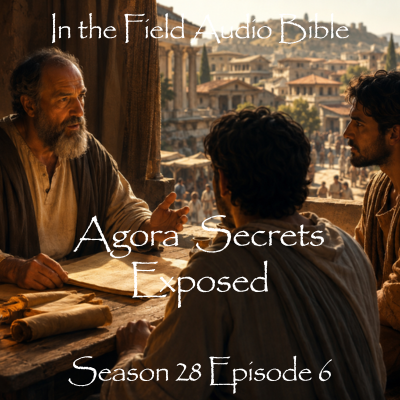
What happens when believers drag each other into the public courts of the agora and call it “justice”? Walk Corinth beside Paul as he exposes the hidden defeat beneath winning, then goes deeper into the real issue: identity. Corinth says, “I belong to myself,” but Christ says, “You are not your own.” This episode is blunt, tender, and strangely freeing, agora secrets exposed, revealing “freedom” that becomes chains, and calling you back to holiness that heals, not shames.
Winning an argument can feel like justice—until you realize it costs your witness. In this episode, we walk the streets of Corinth and sit beside Paul as he names a problem that still hits home. It’s agora secrets exposed: believers dragging one another into public fights, calling it wisdom, and forgetting what it means to live like family.
What You’ll Experience in This Episode
- A cinematic walk through waking Corinth—lamplight, stone streets, and the public pull of reputation
- A close seat beside Paul as he confronts lawsuits among believers and the hidden defeat beneath them
- A deeper descent into identity: “I belong to myself” versus “You are not your own"
- A clear, compassionate call to holiness that heals rather than shames
Key Themes (for Reflection)
- Public conflict and the loss of Christian witness
- Reconciliation over reputation
- True freedom versus being mastered by desire
- The body as a temple of the Holy Spirit
- Belonging to Christ: “bought with a price”
- Resurrection hope shaping everyday choices
Scripture Reading
- 1 Corinthians 6 (full chapter read aloud)
Memorable Images from the Story
- Oil lamps trembling before sunrise in an upper room above a tradesman’s shop
- The agora waking—voices rising, sandals scraping stone, a city hungry for spectacle
- A magistrate’s court as a public stage where “justice” becomes performance
- Ink-dark Greek letters drying on parchment—truth made permanent
- The startling contrast: marble temples outside, a living temple within
Gentle Reflection Questions
- Where are you tempted to “win” at the cost of peace?
- What would reconciliation look like for you right now—practically, not ideally?
- Where have you confused rights with righteousness?
- In what ways does your culture treat bodies as disposable—or desire as a god?
- What changes when you remember: “You are not your own”?
Prayer (Closing)
Lord Jesus, give us the courage to choose reconciliation over reputation. Wash what is proud in us, heal what is wounded, and teach us to live as family. Where desire has mastered us, set us free with a freedom that is holy and whole. Remind us that we belong to You—bought with a price—and help us glorify You in our bodies, in our choices, and in our relationships. Amen.
About This Podcast
In the Field Audio Bible Podcast is a narrative-driven, Scripture-centered journey designed to help you hear God’s Word with clarity and presence. We step into the world of the text—its landscapes, language, and lived realities—so Scripture meets you not as distant history, but as living invitation.
Subscribe + Share
- Subscribe so you don’t miss upcoming readings and story-driven reflections.
- If this episode encouraged you, share it with a friend who needs peace, courage, or a fresh start.
- Leave a review or comment—your words help others find the podcast and join the community.

00:00 - Sponsor Message And Discount Code
01:08 - Welcome And Setting The Space
03:08 - Entering Corinth With Paul
06:21 - Lawsuits Before Unbelievers
10:38 - The Body Belongs To The Lord
17:50 - Quiet Your Heart For Scripture
19:01 - 1 Corinthians 6 Read Aloud
22:50 - Truth That Saves Not Shames
41:23 - Living Holy Freedom Today
42:24 - Closing Prayer And Share Request
In the Field Audio Bible:
The lamps in Corinth have not yet surrendered to morning. Their flames tremble—small tongues of light licking soot-darkened clay, throwing shadows across plastered walls. The night air is cool against your skin, and the rooftop stones beneath your feet still hold the last warmth of yesterday’s sun. Below, the city breathes in layers: a cart wheel groaning, a donkey’s low complaint, sandals on stone. Somewhere near the Lechaion Road, a vendor stirs a pot—garlic, lentils, something sharp enough to wake your hunger. From the gulf comes salt wind and the faint metallic tang of fish. And here, in this upper room above a tradesman’s shop, the air is thick with olive oil and ink. Ink clings to the back of your throat. It stains the fingertips of the man beside you. Paul. He stands at the low table where parchment lies weighted with smooth stones. His robe is plain—undyed wool, travel-worn, hem softened by dust and miles. A mantle rests over one shoulder. Gray threads his hair. His face is lined by prayer, grief, endurance. He looks out the open shutter toward sleeping Corinth, and you wonder what he sees. Not rooftops. Souls. Names.
In the Field Audio Bible:
He remembers the ones who once leaned in close—quick to argue, quick to boast. He remembers baptisms and tears and the bright heat of first love. He remembers the words he has just finished—how they cut, how they warned, how they pleaded. You shift closer, careful not to jostle the lamp. The parchment rasps softly. Paul turns his head, as if he has been listening for you. “Are you awake?” he asks. “I am,” you reply. He nods once. “Good. Corinth doesn’t sleep long. And neither do the troubles of the church.” He sits. The stool creaks. He draws the parchment close, Greek letters marching in careful lines. His finger traces the last lines, then he exhales—slow, measured. “What I wrote was necessary,” he says—no defensiveness, no pride, just truth. “But it cannot stop there.” A rooster calls—sharp and insistent. Paul lifts his eyes to you. “Listen. When a community is proud of its gifts, it becomes careless with its wounds.” “What wounds?” you ask. “The kind that don’t bleed openly,” he says. “The kind that hide behind arguments. Behind rights. Behind the word justice.” He glances toward the window, toward the pale edge of morning. “Tell me—what do you know of Corinth’s courts?”
In the Field Audio Bible:
You picture the agora: merchants shouting, philosophers posturing, magistrates seated high while the crowd gathers for spectacle. “They’re public,” you say. “And loud.” Paul releases a short breath. “Loud.” Sorrow touches the word. “Corinth loves a performance. Men in fine tunics—linen bright, borders dyed for status—rings on their fingers, sandals polished. They accuse one another before unbelievers and call it wisdom.” His gaze sharpens. “But the church is not meant to learn wisdom from Corinth.” A breeze slips through the shutter; the lamp flickers. “And yet,” Paul says quietly, “some are dragging their brothers and sisters into those courts.” “Believers?” you ask. “Believers,” he answers. “Those who share the same bread at the Lord’s table.” His voice lowers, heavy with the shame of it. “They stand in the agora before men who do not know Christ, and they preach with their lives: Look—this is what the followers of Jesus do to each other.”
In the Field Audio Bible:
He holds your gaze. “Do you hear it?” “I do.” “It is a defeat already,” Paul says. “Before any verdict, the church has lost something.” He leans back, letting the truth settle. “Tell me—what is the church meant to be?” “A people set apart,” you answer. “A family. A witness.” “Yes,” Paul says. “A witness.” He turns the quill between his fingers. “Corinth watches everything. Romans, Greeks, sailors, merchants, freedmen, slaves—this city buys and sells nearly anything.” His jaw tightens. “It worships gods who do not speak and treats bodies like bread.” Then his voice softens—pastoral, not harsh. “I am not writing to shame them. I am writing because I love them. They are being pulled back into old ways, and they do not see the danger.” “What will you say?” you ask. “I will ask them,” Paul replies, “why they would rather win than be reconciled.” You blink. “Rather be wronged?” “Yes.” His eyes do not flinch. “Because the cross teaches what Corinth cannot: surrender can be stronger than revenge. Humility can be more powerful than victory.” Outside, Corinth begins to wake—voices rising, a door slamming, pottery clattering. “But I will not stop with the courts,” Paul continues. “Beneath the lawsuits is something deeper.”
In the Field Audio Bible:
He taps the parchment lightly. “Identity. Who they think they are. What they think freedom means.” He looks at you. “Corinth says, I belong to myself. My body is mine. But Christ says, You are not your own.” You think of temples and incense, of Aphrodite’s shadow over the hill. “They teach that pleasure is worship,” you say. Paul nods. “And that the body is disposable—something to use and discard.” His hand presses flat against the table. “But the gospel does not treat the body as disposable.” “The Lord was raised,” he says, steady with certainty, “and He will raise us also.” You feel the bracing weight of it. “Resurrection is for the body, too.” “Yes,” Paul replies. “So the body is not meant for impurity. It is meant for the Lord—and the Lord for the body.” He lowers his voice. “Some say, ‘Food is for the stomach, and the stomach for food,’ as if desire is neutral.” His eyes lift. “But the body is not meant for sexual immorality.” “Paul,” you ask, “how do you teach them to live differently when everything around them says the opposite?” “By reminding them they are joined to Christ,” he says. “Joined.” He speaks carefully now, like a surgeon naming what must be cut away. “A man thinks joining himself to a prostitute is nothing—only a transaction. But Scripture says, ‘The two will become one flesh.’ It is never casual.”
In the Field Audio Bible:
He leans in. “And if you are joined to Christ, your body is not private property. It is a member of Him. Would you take the members of Christ and make them members of sin?” The question searches you. Paul lets the silence do its work. Then his voice turns urgent. “Flee. Not because God is cruel, but because He is kind. Sin does not only break rules; it breaks people.” “Why does it matter so much?” you ask. “Because this sin wounds from within,” Paul says. “Against his own body.” He draws a breath. “And because the believer’s body is not empty. It is a temple.” Not marble. Not incense. Not Aphrodite. “A temple of the Holy Spirit,” Paul says, reverent now. “You have Him because you were given Him.” And then the word lands with Corinthian weight. “Bought,” Paul says. In Corinth, the word carries chains and contracts. Markets and ownership. Flesh priced in coin. “You were bought with a price,” Paul continues. “Not silver. Not gold.” His voice drops. “Blood.” He holds the moment, then speaks plainly. “So glorify God in your body.” Footsteps climb the stairs. A knock. The door opens and a young believer steps in—tunic belted hastily, hair uncombed, bread wrapped in cloth. “Paul,” the young believer says, breathless, “it’s happening again. Two brothers—over money. They’re going to the magistrate today. They want the agora to see who is right.” Paul closes his eyes—sorrow, not surprise—then opens them steady. “Sit,” he tells him. The young man lowers himself to the floor. Paul looks at you. “Do you see?” You nod. “This is why you must hear these words,” Paul says. “Not as a lecture. As a rescue.”
In the Field Audio Bible:
He reaches for the quill. The feather scratches. Ink darkens as it sinks into parchment. “Stay close,” Paul tells you. “Ask what you need to ask. Do not be afraid of the truth. Corinth will offer many freedoms—but only Christ will make you whole.” He lowers his eyes to the page. “Now,” he says, “listen.” The room is quiet except for the scratch of the quill and the hum of Corinth coming alive. You can feel the city pressing in—pride that wants to win, appetites that want to take, old habits that whisper, This is normal. But Paul’s voice is steady, carrying what Corinth cannot manufacture: holiness, belonging, hope. And as he begins—“Dare any of you, having a matter against another, go to law before the unrighteous . . .”—you realize this will confront more than what the Corinthians do. It will confront what they believe about themselves. And what you believe, too.
In the Field Audio Bible:
Now, let’s take a moment to quiet our hearts and listen to the Word itself. As you hear these verses, let them settle deep within you—bringing comfort when you’re weary, conviction when you need direction, and encouragement for whatever lies ahead. Whether you are nestled in a quiet corner or moving through the busyness of your day, allow God’s Word to meet you right where you are and speak to your soul in this very moment. I hope you have your favorite cup of tea or coffee. Sit back, relax, and let’s step into the sacred text of The First Epistle of Paul to the Corinthians Chapter 6.
In the Field Audio Bible:
The First Epistle to the Corinthians 6 (NRSV):
1 When any of you has a grievance against another, do you dare to take it to court before the unrighteous, instead of taking it before the saints?
2 Do you not know that the saints will judge the world? And if the world is to be judged by you, are you incompetent to try trivial cases?
3 Do you not know that we are to judge angels, to say nothing of ordinary matters?
4 If you have ordinary cases, then, do you appoint as judges those who have no standing in the church?
5 I say this to your shame. Can it be that there is no one person wise enough to decide between brothers and sisters?
6 Instead, brothers and sisters go to court against one another, and this before the unbelievers.
7 In fact, to have lawsuits at all with one another is already a defeat for you. Why not rather be wronged? Why not rather be defrauded?
8 But you yourselves wrong and defraud—and brothers and sisters at that.
9 Do you not know that wrongdoers will not inherit the kingdom of God? Do not be deceived! The sexually immoral, idolaters, adulterers, male prostitutes, men who engage in illicit sex,
10 thieves, the greedy, drunkards, revilers, swindlers—none of these will inherit the kingdom of God.
11 And this is what some of you used to be. But you were washed, you were sanctified, you were justified in the name of the Lord Jesus Christ and in the Spirit of our God.
12 “All things are permitted for me,” but not all things are beneficial. “All things are permitted for me,” but I will not be dominated by anything.
13 “Food is meant for the stomach and the stomach for food,” and God will destroy both one and the other. The body is meant not for sexual immorality but for the Lord and the Lord for the body.
14 And God raised the Lord and will also raise us by his power.
15 Do you not know that your bodies are members of Christ? Should I therefore take the members of Christ and make them members of a prostitute? Never!
16 Do you not know that whoever is united to a prostitute becomes one body with her? For it is said, “The two shall be one flesh.”
17 But anyone united to the Lord becomes one spirit with him.
18 Shun sexual immorality! Every sin that a person commits is outside the body, but the sexually immoral person sins against the body itself.
19 Or do you not know that your body is a temple of the Holy Spirit within you, which you have from God, and that you are not your own?
20 For you were bought with a price; therefore glorify God in your body.
In the Field Audio Bible:
Corinth does not know how to be quiet. Even after the Scripture has been read—after Paul’s words have settled into the room like ash after a fire—the city keeps moving below you. You hear it through the open shutter: the scrape of sandals on stone, the bark of a vendor waking his stall, the low argument of men already measuring the day in coin and advantage. The lamp on the table has burned lower. Its flame is smaller now, but steadier—less frantic, as if it has found its work and intends to finish it. Paul’s quill rests beside the parchment. Ink glistens in the grooves of the letters, still fresh enough to smear if you touch it. The air tastes of olive oil and smoke and that sharp, metallic bite of ink—like something permanent being pressed into the world. You realize your hands have gone still. Not because you are afraid. Because you are listening. Paul does not rush to fill the silence. He has never been a man who fears quiet—not when he knows the Lord is near. He sits back on the stool, shoulders slightly rounded from travel and labor, and lets the room breathe.
In the Field Audio Bible:
Below, a shout rises from the street—laughter, then a sharp curse. A donkey brays as if offended by the morning itself. Paul’s eyes lift toward the window, and for a moment you see what he sees: a city dressed in contradictions. Marble temples catching the first pale light. Smoke from household hearths curling into the sky. Priests in clean linen moving toward their rituals. Women in layered tunics and shawls stepping carefully around puddles from last night’s washing. Sailors with salt-cracked hands and foreign tongues, already bargaining for bread. And everywhere—everywhere—bodies. Bodies treated like tools. Like currency. Like something you can borrow and spend and throw away. Paul’s voice breaks the stillness, low and steady. “Do you feel how heavy it is?” he asks. You swallow. “Yes.” He nods, as if he expected nothing else. “Truth is weighty. It does not float over a life. It lands on it.” He reaches for the parchment—not to write, but to hold it, as though the letter itself is a living thing that must be handled with care. His thumb rubs the edge, rough against the fibers. “I did not write these words to win an argument,” he says. “I wrote them to save a people from becoming Corinth.” You glance toward the doorway where the young believer still sits on the floor, bread wrapped in cloth on his lap. He has not eaten. His fingers keep tightening and loosening, tightening and loosening—like a man trying to decide whether he is brave. Paul notices him too. “Tell me your name,” Paul says. The young man blinks, startled to be addressed so gently after such urgency. “Stephanas,” he answers, voice thin with shame. (Not the household leader you have heard of, but a younger man bearing the same name—common enough in a city like this.)
In the Field Audio Bible:
Paul inclines his head. “Stephanas. Look at me.” Stephanas lifts his eyes. “When you say two brothers are going to the magistrate,” Paul asks, “what do you fear most?” Stephanas hesitates. His gaze darts to you, then back to Paul. “That the city will laugh,” he admits. “That they will say we are no different. That . . . that we will lose face.” Paul’s expression softens—not approval, but understanding. “Yes,” he says. “Corinth trains you to fear shame more than sin.” The words hang in the air, and you feel them search you too. Paul leans forward, elbows on his knees, hands open. “But the church belongs to Christ. Not to Corinth. Not to the magistrate. Not to the crowd.” He turns his head slightly toward you. “Do you hear the difference?” You nod. “It’s a different kind of life.” “A different kind of freedom,” Paul replies. Outside, the street grows louder. The sun is climbing. Somewhere, a bronze bell rings—sharp, bright, calling people to commerce, to worship, to whatever god they think will keep their life from collapsing. Paul’s eyes narrow as if he can see the agora in his mind—the stone platform, the seated officials, the spectators who come not for justice but for entertainment. “You know what happens in those courts,” he says to Stephanas. “Men wear their best tunics. They bring witnesses. They speak in polished Greek. They perform righteousness.”
In the Field Audio Bible:
Stephanas nods, jaw tight. “And if a brother wins,” Paul continues, “what does he gain?” Stephanas answers quietly, “Money. Reputation.” “And what does the church lose?” Paul asks. Stephanas’ throat works. “Peace.” Paul’s gaze holds him. “More than peace,” he says. “You lose your witness. You lose your family. You lose the shape of the cross.” The lamp flickers again, and for a moment the shadows on the wall look like moving water. Paul sits back, and his voice changes—still firm, but now like a shepherd calling sheep away from a cliff edge. “I told them, ‘Why not rather be wronged?’” he says. “Not because wrong is good. But because Christ is better than being right.” You feel the resistance rise in you—the old instinct to protect yourself, to demand fairness, to refuse humiliation. Paul sees it. He always seems to. He looks at you, and his tone is almost tender. “You live in a world that worships winning,” he says. “But you were washed.” Washed. The word returns like water over stone. You can almost hear the public bathhouse again—the slap of sandals on wet tile, the echo of voices, the steam rising. Corinth knows washing as ritual, as refreshment, as appearance. But Paul means something deeper. “You were sanctified,” he continues. “You were justified.” Stephanas’ eyes flicker—like a man remembering his baptism, remembering the moment he came up from the water and believed he could be new.
In the Field Audio Bible:
Paul’s voice lowers. “And if you are new, you cannot keep living like you are still owned by the old city.” Owned. The word shifts, and you feel the letter’s other weight—its other confrontation. Paul rises and moves toward the shutter. Morning light spills across his face, catching the gray in his hair. Below, Corinth gleams—beautiful and brutal. He speaks without turning around. “Corinth says the body is for appetite,” he says. “For pleasure. For use.” He turns then, and his eyes meet yours. “But the body is for the Lord.” The sentence is simple. It is also a revolution. You think of the hill where Aphrodite’s temple stands, and the stories whispered about what happens in her shadow. You think of the way the city shrugs at impurity as if it is weather—inevitable, unremarkable. Paul’s voice grows quieter, but it does not soften. “Do you understand why I wrote what I wrote?” he asks. You breathe in slowly. “Because what we do with our bodies says who we belong to.” Paul nods once. “Yes.” He steps back toward the table, and his hand rests near the parchment as if the letter is still speaking. “You are not your own,” he says again, but this time it lands differently—not as a rebuke, but as a refuge. “You were bought with a price.” Stephanas’ shoulders sag, and you realize he has been carrying a burden he does not have words for—trying to be holy in a city that sells holiness like perfume.
In the Field Audio Bible:
Paul looks at him. “Stephanas ,” he says, “you do not have to prove yourself to Corinth.” Stephanas swallows. “But what do I do?” Paul’s answer is not complicated. It is costly. “Go to them,” he says. “Before they go to the magistrate. Go as a brother, not as a judge. Remind them who they are.” “And if they won’t listen?” Stephanas asks. Paul’s eyes hold steady. “Then you keep your hands clean,” he says. “You refuse to participate in their performance. You refuse to call revenge justice.” Stephanas nods slowly, as if the words are painful but true. Paul turns to you again, and his voice shifts—now it feels like he is speaking across time, across distance, into your own life. “Corinth is not only a city,” he says. “It is a way of thinking. A way of justifying. A way of saying, ‘This is normal.’” You feel the sting of recognition. He continues, “And the Spirit of God does not live in you so you can remain normal.” The lamp gives a small pop. The flame steadies again. Paul’s gaze softens. “The Spirit lives in you because you are a temple,” he says. “Not stone and marble—flesh and breath. A living place where God is honored.” You glance down at your own hands—ordinary hands, hands that have held ordinary things, hands that have been tempted to hold what is not yours.
In the Field Audio Bible:
Paul’s voice is gentle now, but it does not let you escape. “So glorify God in your body,” he says. Not in theory. Not in slogans. In your body. In your choices. In the way you treat your brothers and sisters. In the way you refuse to turn people into objects. In the way you refuse to turn your own soul into a marketplace. A shout rises from the street again—someone calling out a price. Another voice answers, bargaining, laughing. Paul’s eyes move to the window one last time. “Corinth will keep selling its version of freedom,” he says. “But freedom without holiness is only another kind of slavery.” He turns back to the table and gathers the parchment carefully, stacking the sheets as if he is gathering a fragile thing. Stephanas rises too, bread still in his hands. He looks smaller than when he entered—less inflated by panic, more grounded by purpose. Paul places a hand on his shoulder. “Go,” he says simply. Stephanas nods, then hesitates. “Paul . . . will they hate me?” Paul’s expression is steady. “Some may,” he says. “But you will be faithful.” Stephanas exhales, then slips out the door and down the stairs, swallowed by the waking city.
In the Field Audio Bible:
The room is quieter now, but not empty. The letter sits between you like a living witness. Paul looks at you—eyes tired, yes, but lit with something unbreakable. “Stay with the words,” he says. “Let them do their work.” You nod, but your throat tightens. “It feels like it’s not only for them.” Paul’s mouth turns slightly—not a smile, not quite, but something like kindness. “It never was only for them,” he says. He moves toward the shutter again and opens it wider. Light pours in. The day is fully awake now. Corinth is glittering below—beautiful, loud, persuasive. And you realize something: the letter does not ask you to escape the city. It asks you to live differently inside it. To be a witness when the world performs. To be a family when the world competes. To be a temple when the world consumes. Paul’s voice is quiet behind you, but it carries. “Remember,” he says, “you were washed.” You close your eyes for a moment and let the words settle—not as information, but as identity. Washed. Sanctified. Justified. Bought. And when you open your eyes again, the city is still there—still loud, still hungry. But you are not helpless in it. You are not your own. You belong to Christ. And that belonging will shape what you do next. Beloved, as you step away from Corinth and back into your own day, don’t let this remain a distant scene—ancient stone, ancient courts, ancient temptations. Ask the Spirit to show you where you’ve been trained to “win,” where you’ve been tempted to perform righteousness, where you’ve treated your body—or someone else’s—as disposable. And then remember this: you were bought with a price. So today, in the ordinary places—your home, your work, your relationships—glorify God in your body. Not with fear. With belonging. With freedom that is holy.
In the Field Audio Bible:
Thank you for sharing this sacred moment with me as we explored these words of hope together. May these words take root in your heart, guiding you through the days ahead and reminding you that God walks beside you—in every challenge, every decision, and every act of faith. If today’s reflection has brought you hope or comfort, I invite you to pass it along to someone who might need a gentle reminder of God’s presence. And don’t forget to come back next time as we continue this journey—growing together, deepening our faith, and remaining steadfast “in the field” of God’s promises. Until next time, may you discover peace in quiet moments, trust the gentle call of God, and rest securely in His unchanging love.
This is In the Field Audio Bible—where we Listen to the Bible One Chapter at a Time.