Apple Podcasts
 Spotify
 Youtube Music
 iHeartRadio
 Amazon Music
 Podchaser
 JioSaavn
  RSS Feed
 God's Real Answer: What Silence Actually Means
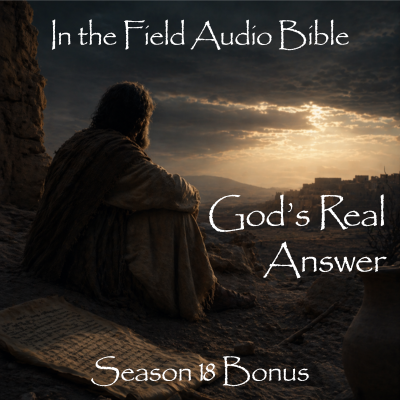
When injustice feels overwhelming, and heaven seems quiet, Habakkuk gives you words to pray and a path to walk. In his raw “How long, Lord?” you begin to hear God's real answer, not a quick fix, but an invitation to honest faith. God’s response is shocking, coming through Babylon, and Habakkuk climbs the watchtower to wait and listen. The righteous live by faith, enduring without denial. In holy silence, Habakkuk learns joy is possible even when fields are empty.
When you look at injustice and feel like heaven is quiet, Habakkuk gives you words to pray and a path to walk. We open the prophet's journal and sit with a conversation that is tender, tense, and deeply human: "How long, Lord?" And in the middle of that ache, you begin to hear God's real answer, not a quick fix, not a cliché, but an invitation to honest faith that stays in the room. Habakkuk refuses to fake faith, yet he also refuses to walk away. If you've ever felt caught between confusion and belief, this is a story for you. And if your heart has been carrying questions you’re almost afraid to say out loud, you’ll find permission here to bring them into the light.
We trace the shock of God's response: judgment is coming, but through Babylon, a ruthless empire that seems worse than the problem it's meant to address. That twist forces a deeper question about God's timing and sovereignty. What do you do when God's plan doesn't look like rescue, and the "solution" feels like another wound? Habakkuk doesn't swallow his questions—he brings them. He climbs to the watchtower, choosing to wait and listen like a sentinel scanning the horizon, eyes open, heart steady, refusing to numb out.
Along the way, we sit with the book's central line, "the righteous will live by faith," not as a slogan, but as a lifeline. Faith here isn't denial; it's endurance. It's staying anchored to God's character when the headlines and the heartache don't match your expectations. We also walk through the five woes that confront greed, injustice, violence, drunkenness, and idolatry—warnings that still read like a mirror for any culture tempted by power, profit, and self-worship.
Then the storm clears into holy perspective: "The Lord is in his holy temple; let all the earth be silent." Not the silence of abandonment, but the hush of awe—God still reigning, God still seeing, God still speaking in ways deeper than noise. Habakkuk ends with a prayer that turns into a song, culminating in a fierce declaration of trust: even when the fig tree doesn't bud, and the fields are empty, joy in God is still possible.
If you're looking for biblical encouragement, spiritual resilience, and language for lament that leads to worship, press play and walk from the watchtower to the heights with us. Subscribe, share with someone who's waiting, and leave a review so more listeners can find this journey.
00:43 - Welcome And Why Habakkuk Matters
01:30 - Habakkuk’s Complaint About Injustice
02:20 - God’s Surprising Answer About Babylon
02:48 - The Watchtower: Choosing To Wait
03:24 - Live By Faith And The Five Woes
04:48 - Holy Silence And God Still Reigns
05:09 - A Prayer Turned Into A Song
06:18 - Joy Without Circumstances And Closing Blessing
In the Field Audio Bible:
Welcome to In the Field Audio Bible. My name is Christie, your host for this special bonus episode. Today we enter the pages of a prophet's journal—the Book of Habakkuk. This isn't a message delivered to a crowd or a king. It's a conversation . . . whispered in the dark . . . between a troubled heart and the God who sometimes feels silent. If you've ever looked at injustice and asked, "Where are You, Lord?"—then this is your story. This is a book not about answers, but about trust. About standing in the gap between confusion and faith—and choosing to wait.
In the Field Audio Bible:
The book opens with a question that has echoed through generations: "How long, Lord, must I call for help, but You do not listen? Or cry out to You, 'Violence!' but You do not save?" (Habakkuk 1:2). Habakkuk isn't afraid to confront God. He sees violence in his own land, injustice in the courts, the wicked swallowing up the righteous. And he dares to ask: "Why do You tolerate this God? Why do You seem silent when evil prevails?" It's a sacred kind of honesty. Habakkuk doesn't walk away from God—he leans into Him, with a trembling voice and relentless questions. And God answers, but not in the way Habakkuk expects. "I am raising up the Babylonians, that ruthless and impetuous people . . ." (Habakkuk 1:6) God reveals that judgment is coming—but through a foreign nation more wicked than Judah itself. It's not the justice Habakkuk hoped for. It's a justice that confuses him even more.
In the Field Audio Bible:
Shaken by God's response, Habakkuk retreats to a solitary place. "I will stand at my watch and station myself on the ramparts . . . (Habakkuk 2:1). He places himself in the role of a sentinel, scanning the horizon not for enemies—but for God. There is something sacred in this moment: a prophet not speaking, but listening. Waiting faithfully, even in frustration. Then, God speaks again—not in wrath, but in wisdom. "Write down the revelation and make it plain on tablets . . ." "Though it linger, wait for it; it will certainly come and will not delay." (Habakkuk 2:2-3) And then these words, at the very heart of the book: "The righteous will live by faith." (Habakkuk 2:4) Not by sight. Not by ease. Not by understanding. But by faith—even when the world seems upside down. In a poetic and powerful rhythm, God pronounces five "woes" over the Babylonian Empire—warnings against greed, injustice, violence, drunkenness, and idolatry. "Woe to him increases . . ." "Woe to him who covets evil gain for his house . . ." "Woe to him who builds his realm by unjust gain . . ." "Woe to him who gives drink to his neighbors . . ." "Woe to him who says to wood, 'Come to life!' or to lifeless stone, Wake up!" (Habakkuk 2:9-19)
In the Field Audio Bible:
These are not just indictments of Babylon—they are mirrors of the nations, for every empire that trusts in power instead of justice. And then, like a sudden clearing in the storm, a verse shines through: "But the Lord is in His holy temple; let all the earth be silent before Him." (Habakkuk 2:20) Even when the world feels broken, God is still enthroned. Even when His timing feels delayed, He is still at work. Habakkuk ends not with another question, but with a prayer. "Lord, I have heard of Your fame; I stand in awe of Your deeds . . ." "In wrath, remember mercy." (Habakkuk 3:2)
In the Field Audio Bible:
The final chapter is a song—raw, thunderous, trembling. The prophet recalls God's mighty acts from the past: how He split seas, shattered mountains, and rescued His people. But now, Habakkuk does not answer for escape. He doesn't plead for understanding. He simply stands, trembling in awe and says: "Though the fig tree does not bud . . ." "Though there are no grapes on the vines . . ." "Though the olive crop fails . . ." "Yet I will rejoice in the Lord . . ." "I will be joyful in God my Savior." (Habakkuk 3:17-18) This is not blind optimism. This is faith forged in the fire—trust that endures, even when everything else is stripped away.
In the Field Audio Bible:
The Book of Habakkuk is a gift to every soul who has ever cried, "How long?" It teaches us that God can handle our questions. That faith is not the absence of doubt, but the choice to trust in the face of it. Habakkuk doesn't get all the answers he wants—but he gets what he needs: a deeper vision of who God is. The story ends with the prophet's feet not in the valley—but high on the mountain: "The Sovereign Lord is my strength; He makes my feet like the feet of a deer, He enables me to tread on the heights." (Habakkuk 3:19) From the watchtower to the heights—this is the journey of every soul that dares to wait for God.
In the Field Audio Bible:
Thank you for joining me for this special bonus episode of In the Field Audio Bible. I pray the Book of Habakkuk speaks to your own valleys of confusion and lifts your eyes toward the God who never fails—even when He seems silent. Until next time, may you find strength in the waiting . . . and joy in the heights.
This is In the Field Audio Bible, where we Listen to the Bible One Chapter at a Time.