Apple Podcasts
 Spotify
 Youtube Music
 iHeartRadio
 Amazon Music
 Podchaser
 JioSaavn
  RSS Feed
 Walls and Whispers: Faith Under Open Threat
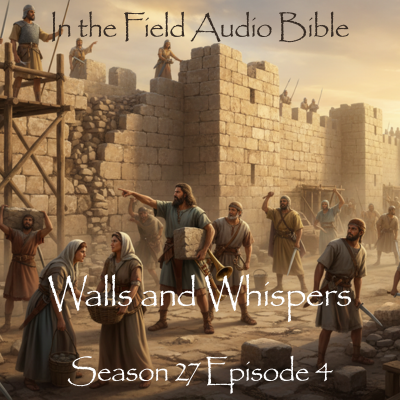
Before dawn, Jerusalem is already awake, and the tension moves through walls and whispers. Builders shoulder stone, stir mortar, and press on with scraped hands and steady resolve. The chapter stays grounded in real work, showing why foundations must sink deep and why oversized stones must be shaped with care to endure. When mockery turns to threat, the answer is prayer joined to planning and watchful order. The wall becomes restored dignity, belonging, and a future rebuilt together.
Mockery is loud. Rubble is heavy. And still, Nehemiah builds through walls and whispers, with prayer in his breath and courage steadying every weary step. We step into Jerusalem before sunrise and feel the grit of Nehemiah 4 like we’re standing in the dust with everyone who showed up to rebuild what was broken. You’ll hear the work up close: stones hauled into place, mortar mixed, hands worn raw, and a leader who refuses to trade conviction for comfort.
As the wall rises, the story turns surprisingly practical. We learn why some stones must be broken down with skill, why foundations must go deep, and why small choices matter when you’re building something meant to last. That craftsmanship becomes a spiritual mirror: patience over anger, wisdom over rush, and faith that looks like steady effort. If you love audio Bible listening, Christian meditation, or scripture-based encouragement, this chapter offers calm and clarity without pretending life is easy.
Then the threats come. Sanbalat and Tobiah mock from a distance, and fear tries to do its work. Nehemiah answers with prayer and a plan: set a guard day and night, stay organized, and keep building. We linger on the unforgettable image of God’s people working with one hand while holding a weapon with the other, learning that courage isn’t the absence of fear, it’s the decision to build anyway.
But do not miss the quiet details that make this chapter breathe. The morning air carries the sharp bite of lime as mortar is stirred, and every stone has a story—some rescued from blackened heaps, some hauled in fresh from the quarry, some too large until a skilled hand breaks them down without wasting what can still be used.
You can hear the scrape of rope, the dull thud of rock settling into place, the brief prayers spoken under breath when a crack runs the wrong way. Nehemiah does not lead from a distance; he walks the line, listens, corrects, steadies. He teaches us that rebuilding is rarely dramatic—it is faithful repetition, measured decisions, and courage that keeps showing up.
We also name what’s really at stake: identity and dignity. The wall is not only defense; it’s a visible testimony that God’s people still belong, still have a future, and still stand together. If this reflection strengthens you, subscribe, share it with a friend who needs steadiness today, and leave a review so more listeners can find this quiet space in Scripture.
In the Field Audio Bible: 00:01
The city wakes before the sun. In Jerusalem, the air is thick with the scent of earth and stone, dew clinging to rough-hewn walls. You stand shoulder to shoulder with Nehemiah, your sandal stirring the dust of a city half in ruins, half in hope. The chill of dawn bites through your tunic—linen, simple, the kind worn by laborers—and the city's wounds are visible in every toppled stone and scorched gate.
In the Field Audio Bible: 03:06
Yet here, among the rubble, the people gather: families, priests, goldsmiths, merchants, each with sleeves rolled, hands callused, hearts set toward one purpose. Nehemiah's gaze is steady, his robe cinched tight against the morning breeze. He wears the garb of a man accustomed to authority—fine linen, a purple stripe along the hem, the signet ring of the Persian king's cupbearer still visible on his finger. But here in Jerusalem, he is no longer a palace official. He is a builder, a visionary, a man who has traded comfort for conviction. He turns to you, voice low, graveled by sleepless nights. "Do you smell it?" he asks quietly, eyes scanning the horizon. You inhale—smoke, sweat, the faint sweetness of figs from a vendor's cart, the acrid tang of lime mortar being mixed in stone basins. "It is the scent of determination," Nehemiah says, his hand gesturing toward the wall. And of opposition."
In the Field Audio Bible: 04:41
The city is alive with the sound of labor: hammers on stone, the scrape of mortar, voices calling out in Hebrew and Aramaic. Women carry baskets of stones on their heads, their robes—dyed indigo and crimson—swaying as they walk. Children ferry water from the well and clay vessels, their bare feet splashing through puddles. The wall, once a monument to despair, is rising—stone by stone, hope by hope. You follow Nehemiah toward the construction site, and the scale of the work becomes apparent. The wall stretches for nearly two and a half miles around the city. In some places, it stands only waist high. In others, it has been reduced to rubble—blackened stones from the Babylonian siege, still bearing the scars of fire. A master builder named Meshullam approaches, wiping sweat from his brow. His hands are weathered, scarred from years of stonework. He wears a short tunic, bound at the waist with a leather belt from which hang tools: a chisel, a hammer, a length of cord.
In the Field Audio Bible: 06:40
"Nehemiah," Meshullam greets him with respect. "The stones from the quarry arrived this morning. But we have a problem." Nehemiah's expression sharpens. "What problem?" "The stones are too large," Meshullam explains, gesturing toward a pile of massive blocks. "The quarrymen cut them for the old wall, before the siege. We need stones of different sizes—some for the foundation, some for the facing, some for the fill. We will need to break many of these down." You watch as Nehemiah kneels beside one of the stones, running his hand along its surface. The rock is rough, ancient, its grain visible in the morning light. "How long will this take?" you ask. Meshullam turns to you. "Days. Perhaps weeks, if we do not have enough workers skilled in stone—breaking. It is not simple work—one wrong strike and the stone shatters into useless fragments." Nehemiah stands, his mind already working through the problem. "Show me the workers you have."
In the Field Audio Bible: 08:03
Meshullam leads you both to a section of the wall where men are engaged in the delicate work of breaking stone. One man, older, with a gray beard and powerful shoulders, raises a stone hammer—a tool made from a heavy piece of wood with a rounded stone head lashed to it with sinew. He strikes a chisel wedged into the stone with precise, measured blows. The stone splits cleanly along its grain. "That is Hanani," Meshullam says. "He is a stoneworker before the exile. He knows the art."
In the Field Audio Bible: 11:43
You watch, fascinated, as the stone breaks into three usable pieces. Hanani pauses, breathing heavily, and notices you observing him. "You are watching how we break stone?" he asks, a slight smile crossing his weathered face. "I am learning," you reply. Hanani nods approvingly. "Then listen. Stone is not your enemy—it is your teacher. You must understand its nature, its grain, its weakness. Strike with anger, and it shatters uselessly. Strike with patience and knowledge, and it yields what you need." Nehemiah listens intently and then asks, "Hanani, if we bring you more workers, can you teach them the skill?" "I can teach willing hands," Hanani says. "But they must understand: this is not quick work. This is the foundation of the wall. If we rush, if we use broken, weak stones, the wall will fail when the enemy comes."
In the Field Audio Bible: 15:03
You move with Nehemiah to another section where the actual wall construction is underway. Here, the work is more complex, more orchestrated. Meshullam explains the process, and you begin to understand the engineering beneath the labor. "The wall must have three parts," he says, pointing to a section where workers are laying stones. "First, the foundation—the largest stones, set deep into the earth. These must be solid, immovable. They bear the weight of everything above." You see men digging a trench, removing soil and debris, preparing the ground. The foundation stones are being set in place, each one carefully positioned, checked with a plumb line—a cord with a stone weight that ensures the wall is perfectly vertical. "Why so deep?" you ask. "Because the enemy will push against this wall," Meshullam replies. "Rain will erode it. Time will weaken it. The foundation must be so strong that it cannot be shaken."
In the Field Audio Bible: 16:51
He continues, "Next, the facing stones—these are the visible stones, the ones you see from outside the wall. They must be smooth, fitted closely together so that no enemy can find a foothold to climb. And finally, the fill—rubble, smaller stones, mortar—packed tightly between the facing stones and the inner wall. This gives the wall its strength, its mass." You watch as workers carry mortar—a mixture of lime, sand, and water—in wooden buckets. The mortar is thick, sticky, and the color of pale clay. A mason spreads it on the foundation stones with a wooden trowel, creating a bed for the next layer. "How do you know how much mortar to use?" you ask the mason, a younger man named Tobias. "Feel," he says, pressing a stone into the mortar. "Too little, and the stone will shift. Too much, and it wastes material and takes longer to set. You learn by doing, by feeling the resistance of the stone, by understanding when the bed is right."
In the Field Audio Bible: 18:16
He shows you with his hands—calloused, stained with lime that has burned his skin in places, leaving white scars. "This work marks you," Tobias says without complaint. "But it is honest work. It builds something that will outlast us all." Suddenly, a trumpet blast splits the morning. The workers pause, hands stilling. Nehemiah's face hardens—he moves among the workers, his presence a steadying force. You see them first: riders on the ridge overlooking the city, silhouettes against the brightening sky. Sanballat and Tobiah, enemies of the work, have brought men with them—not soldiers, but intimidators, men meant to frighten. "Do not be afraid of them," Nehemiah calls, voice rising above the din. "Remember the Lord, great and awesome. Fight for your brothers, your sons, your daughters, your wives, and your homes!"
In the Field Audio Bible: 20:37
A murmur runs through the workers—fear, yes, but also resolve. One builder, a young man named Eliashib, glances at you. His tunic is dust-covered, his hands raw from handling stones. "Will you stand with us?" he asks, voice trembling but brave. Before you can answer, Nehemiah places a reassuring hand on your shoulder. "We stand together," he says. "Each family, each stone, each heart. The wall is not just for defense—it is for dignity. It says to the world: we are here, we are whole, we are God's people." You feel the weight of his conviction, and it steadies you. Sunlight creeps over the Mount of Olives, gilding the city in gold. Shadows retreat, but the threat does not. Nehemiah leads you to a lookout, where the city's defenders—swords strapped over linen robes—scan the horizon. These men are not soldiers by trade; they are merchants, priests, craftsmen who have taken up arms to protect their families and their work.
In the Field Audio Bible: 22:14
"We work with one hand and hold a weapon with the other," Nehemiah explains, his eyes never leaving the distance. "God fights for us, but we must be ready." You notice the organization now—half the workers labor on the wall while the other half stand guard, weapons at hand. Every few hours, they switch. It is exhausting, you realize. It is not just the physical labor of the building; it is the constant vigilance, the tension of knowing that enemies surround the city. A guard named Shelemiah approaches Nehemiah. "The men are asking about the night watch," he says. "Some have families outside the wall, in the villages. They want to know if they can return home."
In the Field Audio Bible: 24:30
Nehemiah considers this carefully. "No one leaves the city after dark," he says firmly. "We sleep in our armor, our weapons at hand. Tell them: the wall is not yet complete. Until it is, we are all soldiers first, builders second." You turn to Nehemiah. "Is that not harsh? These men have families—" "Yes," Nehemiah interrupts gently. "And those families are safer because we protect the wall. If the wall falls, everything falls. Every sacrifice now prevents greater suffering later."
In the Field Audio Bible: 25:15
Now let's take a moment to quiet our hearts and listen to the Word itself. As you hear these verses, let them settle deep within you—bringing comfort when you are weary, conviction when you need direction, and encouragement for whatever lies ahead. Whether you are nestled in a quiet corner or moving through the busyness of your day, allow God's Word to meet you right where you are, and speak to your soul in this very moment. I hope you have your favorite cup of tea or coffee. Sit back, relax, and let's step into the sacred text of The Book of Nehemiah 4.
The Book of Nehemiah 4 (NRSV):
1 Now when Sanballat heard we were building the wall, he was angry and greatly enraged, and he mocked the Jews.
2 He said in the presence of his associates and of the army of Samaria, "What are these feeble Jews doing? Will they restore it by themselves? Will they offer sacrifice? Will they finish it in a day? Will they revive the stones out of the heaps of rubbish—burned ones at that?"
3 Tobiah the Ammonite was beside him, and he said, "That stone wall they are building—any fox going up on it would break it down!"
4 Hear, O our God, for we are despised; turn their taunt back on their own heads, and give them over as plunder in a land of captivity.
5 Do not cover their guilt, and do not let their sin be blotted out from your sight, for they have raged against the builders.
6 So we rebuilt the wall, and all the wall was joined together to half its height, for the people had a mind to work.
7 But when Sanballat and Tobiah and the Arabs and the Ammonites and the Ashdodites heard that the repairing of the walls of Jerusalem was going forward and the gaps were beginning to be closed, they were very angry,
8 and all plotted together to come and fight against Jerusalem and to cause confusion in it.
9 So we prayed to our God and set a guard as a protection against them day and night.
10 But Judah said, "The strength of the burden bearers is failing, and there is too much rubbish so that we are unable to work on the wall."
11 And our enemies said, "They will not know or see anything before we come upon them and kill them and stop the work."
12 When the Jews who lived near them came, they said to us ten times, "From all the places where they live they will come up against us."
13 So in the lowest parts of the space behind the wall, in open places, I stationed the people according to their families, with their swords, their spears, and their bows.
14 After I looked these things over, I stood up and said to the nobles and the officials and the rest of the people, "Do not be afraid of them. Remember the LORD, who is great and awesome, and fight for your kin, your sons, your daughters, your wives, and your households."
15 When our enemies heard that their plot was known to us and that God had frustrated it, we all returned to the wall, each to his work.
16 From that day on, half of my servants worked on construction, and half held the spears, shields, bows, and body-armor, and the leaders posted themselves behind the whole house of Judah
17 who were building the wall. The burden bearers carried their loads in such a way that each labored on the work with one hand and with the other held a weapon.
18 And each of the builders had his sword strapped at his side while he built. The man who sounded the trumpet was beside me.
19 And I said to the nobles, the officials, and the rest of the people, "The work is great and widely spread out, and we are separated far from one another on the wall.
20 Rally to us whenever you hear the sound of the trumpet. Our God will fight for us."
21 So we labored at the work, and half of them held the spears from break of dawn until the stars came out.
22 I also said to the people at that time, "Let every man and his servant pass the night into Jerusalem, so that they may be a guard for us by night and may labor by day."
23 So neither I nor my brothers nor my servants nor the men of the guard who followed me ever took off our clothes; each kept his weapon in his right hand.
In the Field Audio Bible: 33:10
The day unfolds in a rhythm of labor and vigilance. You help pass stones, your hands raw but your spirit alight. The work is harder than you imagined—each stone weighs more than you expected, and the heat of the day intensifies as the sun climbs higher. By midday, the air shimmers above the stones. Sweat soaks through your tunic. Your shoulders ache. You pause, breathing heavily, and a woman named Noadiah approaches with a water vessel—clay, cool from the well. "Drink," she says kindly. She wears the dress of a merchant's wife, but her hands show she works alongside the men. "You are new to this labor." I am learning," you say, drinking deeply. "We are all learning," Noadiah replies. "Three months ago, I had never lifted a stone. Now, I help carry them. My children help too. We do this together, as a family, as a city."
In the Field Audio Bible: 34:44
She gestures toward the wall. "Do you see how the stones fit together? Each one is different, but each one has its place. That is what Nehemiah has taught us—that we are not individuals working alone. We are parts of something larger, something that will protect us all." You thank her and return to the work, but her words stay with you. As the afternoon wanes, Nehemiah pauses beside you, sharing bread and quiet conversation. The bread is dark, made from barley, and it is accompanied by dried figs and a small portion of cheese. You sit on a pile of stones, looking out over the city. "Why do you risk so much?" you ask him. "You had comfort in Persia. You had the king's favor. Why come here to this broken city, to face this opposition?" Nehemiah is silent for a moment, chewing his bread thoughtfully. "Because this city is not just stone and mortar," he finally says. "It is promise, it is testimony. It is God's dwelling among His people. When I was in Susa, in the palace, I heard that Jerusalem's walls were broken, its gates burned. And I wept. I could not eat. I could not sleep.
In the Field Audio Bible: 36:40
He looks at you directly. "Do you know why?" "Why," you ask? "Because a city without walls is a city without identity. It is vulnerable, exposed, ashamed. The walls are not just for defense—they are for dignity. They say: we belong here. We are a people. We have a future." You absorb this, understanding now the deeper meaning of the work. "But the opposition," you say. Sanballat, Tobiah—they will not stop. They will keep trying to frighten us, to stop the work." "Yes," Nehemiah agrees. "And we must be ready. But notice something: they mock us from a distance. They do not come close. They do not dare to touch the wall or the workers. Why? Because they see that we are organized, that we are unified, that we are willing to defend what we are building." He breaks off another piece of bread. "Fear is a tool they use," he says. "But faith is a stronger tool. When the people see that we do not fear, that we trust in God and in each other, their fear loses its power."
In the Field Audio Bible: 39:17
As dusk falls, the air cools, and torches flicker along the ramparts. The workers do not remove their clothes—each keeps a weapon at hand, even as they rest. The wall has grown noticeably since morning; perhaps twenty feet of new construction has been completed, the stones laid, the mortar set. Meshullam approaches Nehemiah with a report. "We have made good progress today. At this rate, if the opposition does not escalate, we can complete the wall in perhaps two more months." "And if the opposition does escalate?" Nehemiah asks.
In the Field Audio Bible: 41:08
"Then we must work faster, with more men, in shifts. We cannot afford to stop." Nehemiah nods, absorbing this information. He turns to you. "You see how the work requires not just labor, but strategy? We must know our capacity, our timeline, our vulnerabilities. We must plan for the worst while hoping for the best." You sit with Nehemiah beneath the stars, his voice soft as the city settles into night. Around you, men take their positions on the wall, weapons at hand, eyes alert. "Courage is not the absence of fear," Nehemiah says, "but the decision to build in spite of it. Share this with others—let them know what it means to stand firm, to trust, to build. Let them know that the walls of Jerusalem are rising not because we are strong, but because God is faithful." He places a hand on your shoulder. "You have worked well today. Tomorrow you will work again. And the day after that. This is not quick work. This is the work of faith—slow, steady, persistent. But it is the work that changes everything."
In the Field Audio Bible: 44:15
You look out over Jerusalem as night deepens. The torches along the wall cast dancing shadows. The city is alive with quiet activity—men checking weapons, women preparing food for the next day, children sleeping in the shelter of the partially rebuilt gates. You realize you are no longer a bystander. You are a builder, a watcher, a disciple—learning from Nehemiah, living the story as it unfolds. The stones beneath your feet, the mortar on your hands, the weight of the work in your muscles—these are real. This is real. And as you drift towards sleep, wrapped in your cloak on the hard ground beside the wall, you understand what Nehemiah meant: the wall is not just about defense. It is about identity, about community, about faith made visible in stone and mortar and the willing hands of a people who have decided to build together, no matter the cost.
In the Field Audio Bible: 46:05
Thank you for sharing this sacred moment with me as we explored these words of hope together. May these words take root in your heart, guiding you through the days ahead and reminding you that God walks beside you—in every challenge, every decision, and every act of faith. If today's reflection has brought you hope or comfort, I invite you to pass it along to someone who might need a gentle reminder of God's presence. And don't forget to join me next time as we continue this journey—growing together, deepening our faith, and remaining steadfast "in the field" of God's promises. Until next time, may you discover peace and quiet moments, trust the gentle call of God, and rest securely in His unchanging love.
This is In the Field Audio Bible, where we Listen to the Bible One Chapter at a Time.